Tomahawk Ribeye and Vintage wines for Celebration dinner
We hosted son Sean and d-in-law Michelle and family for a mini-celebration dinner for a recent business and career milestone that will be announced soon. I pulled from the cellar a birthyear vintage bottle for both his and Michelle’s birthyears - two big reds to accompany the grilled tomahawk ribeye beefsteak.
Linda also prepared sweet corn, roasted potatoes, a medley of mixed vegetables, and Sean prepared baby artichokes.


Dunn Vineyards Napa Valley Cabernet Sauvignon 1985
If you’re acquiring wines to commemorate a special vintage year for a future date, such as a birthyear, you select a producer with a track record for producing long lived wines, and select wine from a region that had a good harvest of quality fruit suitable for producing long-lived wines.
Hence we hold a collection of such wines from Randy Dunn, the legendary, independent Napa Valley winemaker known for pioneering producing powerfull structured, age-worthy Cabernet Sauvignons. His 1985 Cabernet Sauvignon has shown longevity, maintaining incredible freshness and structure even four decades after harvest.
Randy Dunn helped shape the modern identity of Napa Valley. After studying enology at UC Davis, Dunn became the first head winemaker at Caymus Vineyards in 1975 where Caymus launched its legendary ultra-premium Special Selection Cabernet.
In 1978, Dunn and his wife Lori bought property atop Howell Mountain where he was instrumental in getting established the Howell Mountain AVA, which in 1983 became Napa’s first official sub-appellation.
While modern Napa moved toward micro-sorted, plush, high-alcohol wines, Dunn maintained his traditional style, crushing fruit with bits of stems intact for raw structure, and aging wines no less than thirty months in oak, crafting balanced, elegant, lower alcohol wines designed for the dinner table.
Dunn Vineyard’s Howell Mountain property is planted with 24 acres of Cabernet vines aging between 10-37 years.
We’ve written about Randy Dunn and select wines before in these blogposts -
Dunn Vineyards and Caymus #40 Napa Valley Cabernet Sauvignons,
Dunn Vineyards Napa Valley Cabernet Sauvignon 1999
We visited the Dunn Vineyards estate up at Angwin on Howell Mountain during our Napa Valley Howell Mountain Wine Experience back in 2008. We were hosted by Kristina Dunn that day but we had the privilege to meet winemaker, producer, patriarch and Napa Valley pioneer Randy Dunn.
While not one of the larger holdings in our cellar in terms of number of bottles, it may be one of our broadest holdings in terms of number of vintages in our vertical collection of this label, and the flagship premium label Dunn Howell Mtn Cab. We also collect Randy Dunn's "Feather" label that he produces for the Long Shadows Vintners Collection Series in Washington State.
Our Cellartracker records indicate we have a vertical collection of several mixed cases of each label from almost two dozen vintages dating back to 1981.
 |
| Selections from Vertical Collection of Dunn Napa Valley Cabernets |
 |
| With Randy Dunn at Dunn estate high atop Howell Mountain. |


Back in the 1980’s this vintage release was rated 94 points and “Top 100 Wines of 1988” by Wine Spectator, and 93 points by John Gillman as late as 2021.
Amazingly, at 40 years of age this 1985 Napa Cabernet Sauvignon is still holding its own showing some but little sign of diminution from age. The fill level, foil, label and most importantly the cork, were all in good, acceptable condition.
The bottle still has the pricetag sticker on the bottle showing $54.95, which would've been the purchase price back on release in the late 1980's.
In his 2021 review of this label, John Gilman wrote, “I last drank the 1985 Napa cabernet from Randy Dunn back in early 2018 and felt it was starting to turn the corner. However, at one of our most recent tastings, it was back in its tannic suit and tie and demanding to be left alone in a cool corner of the cellar for another ten-plus years.’
“The potential here remains exceptional, but I was hoping to see even a bit more softening of the tannins, rather than a still closed and cantankerously-structured wine!”

“The bouquet is excellent, wafting from the glass in a complex blend of cassis, sweet dark berries, stony soil tones, cigar smoke, incipient notes of petroleum jelly, pretty spice tones, a touch of road tar and cedary oak. On the palate the wine is deep, full-bodied and still pretty clenched in its tannic chassis, with a lovely core, excellent soil signature and grip, firm, chewy tannins and a long, nascently complex and still very promising finish. Was my last bottle more forward, or is this bottle from a particularly cool cellar? I am not sure, but this most recent bottle needs still more time in the cellar before it starts to drink with generosity. Someday, it should be a terrific bottle of wine! (JG) 93+”
Wine Spectator wrote of this release - “Intense and concentrated, packed with ripe cassis, cherry and currant flavors that are rich and elegant. The acidity and tannins are crisp and juicy, offering great potential for the cellar.”
This was dark garnet colored, medium bodied, tangy dark blackberry and black raspberry fruits holding on, accented by notes of tobacco, spice, leather, hint of graphite, espresso and cassis with nicely integrated tannins on a round lingering finish.
RM 90 points.
https://go.cellartracker.com/wine/18231
@dunn_vineyards
Marston Cellars Napa Valley St Helena Petit Syrah 1984
This is the last bottle from the 1984 vintage that we hold in our cellar, since it was not a collectable year, nor a birthyear of note at that time. I wrote about this label back in 2018 in this blogpost which I repeat excerpts here.
My notes from an earlier review of this wine back in 2004 on this label's vintage twentieth anniversary.
"Dec 31 - Marston (Family) Vineyard Napa Valley Petit Syrah 1984 (Bottle 790 of 812) - RM 90 - Today, 'Family' is part of the name and the winery provides cabernet fruit for Beringer Private Reserve. Not many 20 year olds down in the cellar (since the 84 Bordeaux's are long gone being a short lived vintage) but pulled this one out on the last day of 04... Surprising body, structure and backbone with inky purple colour. Intense currant, black cherry, cedar anise and plum with a firm tight long full finish. Amazing staying power and life left - thankfully I have at least one more ... 2014?
From the Marston (Family) Vineyard website - Over the last 25 years, the Marston Vineyard has produced numerous award winning wines.Andre Tchelistcheff helped craft small quantities of Cabernet Sauvignon, Petite Sirah, and Zinfandel in the early 1980’s. Sean Thackery produced legindary Petite Sirahs from the Marston Vineyard in the early 1990’s winning Best Red Wine in the world. For the last decade Beringer has been responsible for the vineyard. Cabernet Sauvignon from Marston Vineyard is in the Beringer Private reserve Cabernet. Marston Vineyard designated Cabernet is also made by Beringer. The year 1998 marked the beginning of a new era for Marston Family Vineyard. The first Marston Family Vineyard Cabernet Sauvignon was made by one of our favorite and noted winemakers, Philippe Melka."
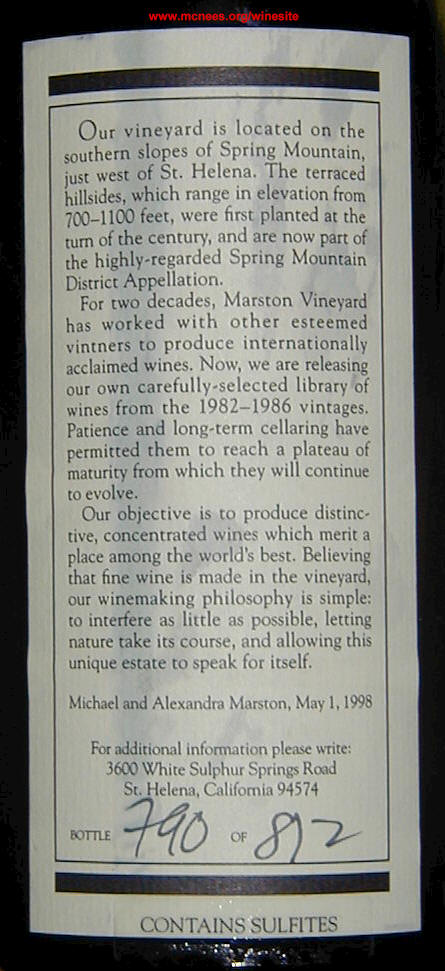
We missed pulling this wine in its thirtieth anniversary year, 2014, but here we are four years later. At thirty-four this is still holding its own showing surprising vibrancy and resilience and no signs of diminution from age. And my earlier notes indicating we still held a bottle missed the fact we were holding two. Hence, after drinking this one, we still hold one more. As shown on the rear label of this wine, released from library in 1998, it was built for long term cellaring. It is standing up to that objective indeed!
According to the Marston Family website today regarding their wines, each vintage will remain “forever limited” to 600 cases and is produced from selected blocks on the property. According to the handwritten serial numbers on these bottles, exactly 812 bottles were produced of this wine.
Marston Family Vineyards dates back to Michael and Alexandra Marston purchasing the property back in 1969 as part of a consortium. then acquiring the remaining ownership in 1976. Back in 1969, many of the original vineyards dating back to the turn of the century were still in production.

Over the next four decades, Marston Family Vineyardhad a line of legendary winemakers who produced numerous award winning wines. In the early 1980’s, Philip Togni and the late Andre Tchelistcheff crafted small quantities of Cabernet Sauvignon, Napa Rhone (this Petite Sirah) and Zinfandel.
This vintage was among the vintages from 1982 – 1986 that were overseen by legendary André Tchelistcheff, who was considered America’s most influential post-Prohibition winemaker, and was notable for his contributions toward defining the style of California’s best wines, especially Cabernet Sauvignon. Called the “Dean of American winemakers”, industry giants such as Robert Mondavi and Louis Martini considered him their mentor.
Noted winemaker Sean Thackery produced legendary Petite Sirahs from the Marston Vineyard under his Sirius label through the early 1990’s including winning “Best Red Wine in the World” with the 1992 (some records say 93) vintage.
Noted winemaker Philippe Melka and his team managed the property and winemaking for a dozen vintages up until 2010. During this time they began replanting certain blocks of the vineyard, and in 1998 released the first vintage under the current label.
The release of the 2010 vintage marked the first release of current winemaker, Marbue Marke who continues to this day.

My notes from an earlier review of this wine back in 2004 on this label's vintage twentieth anniversary.
"Dec 31 - Marston (Family) Vineyard Napa Valley Petit Syrah 1984 (Bottle 790 of 812) - RM 90 - Today, 'Family' is part of the name and the winery provides cabernet fruit for Beringer Private Reserve. Not many 20 year olds down in the cellar (since the 84 Bordeaux's are long gone being a short lived vintage) but pulled this one out on the last day of 04... Surprising body, structure and backbone with inky purple colour. Intense currant, black cherry, cedar anise and plum with a firm tight long full finish. Amazing staying power and life left - thankfully I have at least one more ... 2014?
From the Marston (Family) Vineyard website - Over the last 25 years, the Marston Vineyard has produced numerous award winning wines.Andre Tchelistcheff helped craft small quantities of Cabernet Sauvignon, Petite Sirah, and Zinfandel in the early 1980’s. Sean Thackery produced legindary Petite Sirahs from the Marston Vineyard in the early 1990’s winning Best Red Wine in the world. For the last decade Beringer has been responsible for the vineyard. Cabernet Sauvignon from Marston Vineyard is in the Beringer Private reserve Cabernet. Marston Vineyard designated Cabernet is also made by Beringer. The year 1998 marked the beginning of a new era for Marston Family Vineyard. The first Marston Family Vineyard Cabernet Sauvignon was made by one of our favorite and noted winemakers, Philippe Melka."
Over the next four decades, Marston Family Vineyardhad a line of legendary winemakers who produced numerous award winning wines. In the early 1980’s, Philip Togni and the late Andre Tchelistcheff crafted small quantities of Cabernet Sauvignon, Napa Rhone (this Petite Sirah) and Zinfandel.
This vintage was among the vintages from 1982 – 1986 that were overseen by legendary André Tchelistcheff, who was considered America’s most influential post-Prohibition winemaker, and was notable for his contributions toward defining the style of California’s best wines, especially Cabernet Sauvignon. Called the “Dean of American winemakers”, industry giants such as Robert Mondavi and Louis Martini considered him their mentor.
Marston Family Vineyards sit on the most southern slopes of Spring Mountain on the western slopes of Napa Valley above the town of St Helena. The original vineyards date back to the late 1800s and over the years were planted with as many as eleven different varietals, including Johannesburg Riesling, Pinot Blanc, Petite Sirah, Zinfandel, and Cabernet Sauvignon. This 1984 vintage of the Marston Petite Sirah was sourced from a small 3-acre plot on the property where some of those first plantings were done back as early as 1890.
As noted, this was our last remaining bottle.