Showing posts with label Right Bank. Show all posts

Sunday, August 23, 2026

Domaine L’Eglise Pomerol with grilled beefsteak

Domaine L’Eglise Pomerol with grilled beefsteak

Home alone for the evening, I grilled a petit filet of beef for dinner, served with Mac-n-cheese and balsamic hot-house tomato’s. To pair with the dinner, I pulled from the cellar an aged Right Bank Bordeaux. 


With wife Linda gone, I pulled an aged bottle beyond the years she would enjoy drinking, yet still in its approachable (albeit near the end) drinking window - a 1989 vintage Bordeaux. 

The 1989 vintage in Pomerol is widely considered a legendary, stellar year that produced some of the greatest and most opulent Merlot-based wines of the 20th century. As I have written often, ‘all boats rise with the tide”, such that in stellar vintage years, even the lesser known labels are excellent and can provide great values as the quality nears that of the premier producers. 

As an appellation, perhaps Pomerol was the most successful region for quality 1989 Bordeaux wine, partly due to the fact that the Merlot varietal faired extremely well for the vintage. The 1989 release of great First Growth from Pomerol, Chateau Haut Brion is considered one of the great wines of the century, along side the historic 1961, 1959 and perhaps even 1945 Haut Brion.

The 1989 growing season was warm, early-maturing year that resulted in abundant yields and very healthy, sugar-rich grapes. Many of the 1989 labels are still drinking well and top producers will can be held perhaps another decade, although most labels should be monitored closely and consumed soon. 

Domaine L’Eglise Pomerol Bordeaux 1989

At thirty-six years, the foil and label were still in pristine condition, and most importantly, the fill level was bottom neck, acceptable for such an age, and the cork was still in good condition.

This is the last bottle of several collected years ago. The previous bottle was consumed and posted in this earlier blogpost - https://unwindwine.blogspot.com/2025/05/aged-vintage-wines-for-family-birthday.html.

Château du Domaine de l'Eglise Pomerol 1989

Château du Domaine de l'Eglise is a renowned producer of Right Bank Bordeaux wine, located in the commune of Pomerol, in the shadow of the church tower, and less than two kilometres, within walking distance, of notable famous neighbor producers Château Clinet (300m) and Château Petrus (900m), Chateau LEvangile and Chateau LEglise Clinet. 

The Pomerol AOC (Appellation Originale Controllee) is located in the Libourne region on the Right Bank of the Dordogne River, just upstream from its confluence with the Isle. The town of Libourne, has a port that was used for exporting wines as far back as 1269. 

In the 1900s, winegrowers got together and made joint purchases. Working together, they set up a winegrowers’ and farmers’ union to improve their wine and protect the Pomerol appellation. The AOC area was defined in 1928, recognised in 1936 and revised in 2011.

Today, the Pomerol AOC is renowned for its great wines such as Pétrus, Trotanoy, Clinet, Petit Village and Gazin. The Pomerol appellation comprises nearly 2000 acres with 140 producers with an average of 15 acres, producing 31,000 hectolitres of red wine a year.

Domaine de l’Eglise is one of several Pomerol producers using L’Eglise as part of their name. Domaine de l’Eglise is thought to be the oldest vineyard in the entire Pomerol appellation. It is thought that the estate was founded in the 16th century. There are records dating the estate back to 1589. 

The vineyard is located not far from several famous neighbors including Chateau LEvangile, Chateau Clinet, and Chateau LEglise Clinet. While they have parcels in various locations on the plateau, their best parcels are planted close to the village church, not far from their old, stone chateau.

The origins of the Château du Domaine de l’Église vineyard can be traced back to 1589, at the beginning of the reign of the Good King Henri (Henri IV). The estate was seized by authorities during the French Revolution and in 1793 it was sold to the Bertin family though a national property sale.

In 1893, the Bertin family produced ten barrels of wine, rising to twenty barrels by 1949. Simon Landard, Laure Bertin’s nephew, ran the estate a few years later. The estate was acquired in 1973 by Émile Castéja, 

Château du Domaine de l’Eglise was owned by Philippe Castéja and his sister, Chantal Castéja Prében-Hansen. Philippe ran the estate and improved the quality of the wine over the years. The wine from Château du Domaine de l’Eglise is considered a Grand Vin. Today the estate is run by the firm of Borie-Manoux.

The vineyards of Domaine de l’Eglise were completely replanted following a devastating frost in 1956. At that time, the estate made a management and sales agreement with Borie Manou.

In 1972, the Landard family, who had owned the vineyard since 1793, sold Domaine de l’Eglise to the well-known Castéja family, owners of Batailley and Trotte-Vieille. Borie Manou and Philippe Castéja were placed in charge of managing the Pomerol estate. 

Starting with the 2009 vintage, the quality of wine being produced at Domaine de l’Eglise took a turn for better.

The 17 acre Pomerol vineyard of Domaine de l’Eglise is planted to 95% Merlot and 5% Cabernet Franc. 

On average, the vines are an impressive 40 years of age at Domaine de l’Eglise Pomerol. The vineyard is situated on a plateau with classic Pomerol terroir, characterized by gravelly soil and clay subsoil, which imparts a distinct minerality to the wine

The wine is typically aged in an average of 40% new, French oak barrels for between 16 and 18 months, depending on the character and style of the vintage, before bottling. 

On average, the annual production hovers close to 2,500 cases of Pomerol wine per vintage at Domaine de l’Eglise. 

At thirty six years, this wine was holding up remarkably well and still very much in its drinking window, but certainly not likely to improve with any further aging, and best to be consumed in the next couple years. The label and foil and most importantly the fill level was top of neck and the cork was still intact despite being partly saturated, it was holding its integrity. It was carefully extracted using an ‘Ahso’ two pronged cork puller (shown). It likely would have collapsed in the bottle if pressed by a traditional cork screw. I always use this method, especially with older wines (except for synthetic corks).  

This release was awarded 90 points by Wine Advocate in 1993. 

This was even better the following day, being more balanced and settled, after decades of aging in the cellar.

Dark blackish garnet colored, medium to full bodied, deep rich round ripe balanced blackberry, cherry and plum fruits with herbs and vibrant spice notes with soft fine tannins on a long sensuous finish. 

RM 90 points, better, 91 points the following day. 


https://go.cellartracker.com/wine/186048


Saturday, February 14, 2026

Birthday celebration dinner at Morton’s Steakhouse Naperville

Birthday celebration dinner at Morton’s Steakhouse Naperville

Last week we had a birthday celebration dinner with two of our kids and spouses, featured in these pages in this blogpost - Birthday dinner celebration at Petit Vie Western Springs.

 
Tonight, we had another birthday celebration dinner with son Ryan and his family, dining at Morton’s Steakhouse, Naperville for a festive dinner. 


Naturally we ordered steaks, all prepared and presented perfectly, including my special “‘Pittsburgh style’, hot pink center, charred”.

For starters each couple share a wedge salad. 

For sides we ordered the Mashed Potato’s and the spinach and Brussels sprouts. 

I brought BYOB from our home cellar a couple special bottles from which to choose for pairing with dinner. We opted for this premium Washington State Columbia Valley Right Bank Bordeaux Blend. 

Force Majeure Épinette Red Mountain Red Blend 2015

We discovered, tasted and acquired this label while visiting the producer during our Walla Walla Wine Experience in 2018, which we featured in this blogpost - Force Majeure Vineyards Site Visit and Tasting.

Épinette is Force Majeure's Right-bank Bordeaux-inspired blend, and was named after an avenue in Libourne that leads to Pomerol and Saint-Émilion, the home of Merlot and Cabernet Franc.

Épinette is also the name of a musical instrument akin to a piano, as well as a word for pine tree, which is a fitting nod to the locale's in Washington state.

Bordeaux blend in the 'Right Bank' style meaning it is primarily Merlot and Cabernet Franc, with smaller amounts of Cabernet Sauvignon and Petit Verdot.

The 2015 is blended in a Pomerol style, 50% Merlot, 30% Cabernet Franc, 16% Cabernet Sauvignon and 4% Petit Verdot

The Merlot and Cabernet Franc are grown in the lower areas of the Red Mountain vineyard with its  deep, well-drained soils.

The Red Mountain Right-bank Bordeaux inspired blend, “Épinette,” spent 22 months in 75% new French oak after a long maceration and fermentation in both concrete and stainless steel vats. 

The blend changes each vintage, either being dominated by Merlot or Cabernet Franc, but in 2015 it is driven by Merlot grown in deep, loamy soils found in the heart of our vineyard. Bottled unfined and unfiltered.

The Force Majeure Épinette was the perfect complement to our aged prime steak dinner, perfectly prepared 'Pittsburgh' style, served with mashed potatoes. 


This release was rated 95 points by Robert Parker's Wine Advocate, 94 points by Jeb Dunnuck, and  90 points by Wine Spectator 

Silky tannin' 'Legs' of Force Majeure Epinette
Dark garnet colored, medium full bodied, bright vibrant forward black berry, ripe black raspberry and black current fruits with notes of cigar box, mocha chocolate, hints of leather, anise, graphite and spicy oak with gripping but approachable silky tannins on the lingering finish. 

RM 94 points. 


Tonight tasting was consistent with another tasting recently of this same label that we took BYOB at another steak dinner, featured in detail and replayed below. 

https://unwindwine.blogspot.com/2025/08/vintij-sandestin-food-and-wine-dinner.html

Vin’Tij SanDestin Food and Wine Dinner 


After a fun-filled afternoon of wine paired with foods at Vin’Tij Food & Wine, we booked a table for a follow-on Saturday night dinner. I wrote about that wine tasting in this blogpost - Wine tasting at Vin’Tij Grand Boulevard (San)Destin.

The plan was to drink BYOB one of the ultra-premium bottles we purchased in the Vin’Tij Wine Boutique for the occasion.

I write often in these pages about the price charged by restaurants for their wines, often expressed as a function of the retail price of the wine. It is customary that a restaurant charges 2 times the retail price of a wine. Often the restaurant price is 2.5 times or more. 

Establishments that combine a restaurant with a wine retailer provide the best and most economical scenario for the consumer whereby the restaurant price equals near the retail price - a 1:1 ratio. In this scenario, the restaurant is relying solely on the gross margin uplift between the wholesale price paid and the retail price charged the diner. 

Two such establishments exist in Destin, Vin’Tij and also Chan’s Wine World that is connected to and associated with the adjoining Wine Bar restaurants. Diners seeking a food and wine experience can leverage these policies for great value dining. And, they can take the opportunity to upgrade their wine choices with higher premium or ultra-premium wines they otherwise not be able to afford or justify for wine experimentation or appreciation!   

For our Saturday Night Vint’Tij dinner, we were joined by Richard and Victoria, friends and neighbors in our Destin residential community. 

Planning to order grilled beefsteaks for our entrees, I took BYOB a Washington State Columbia Valley Red Bordeaux Blend from Force Majeure. 

This is from Force Majeure Vineyards, originally called Grand Reve, founded in Woodinville, near Seattle, in 2004, a collaboration between businessman Paul McBride and vineyard manager Ryan Johnson who spent a decade managing vineyards in Eastern Washington’s prestigious Red Mountain AVA. 

McBride and his wife Susan then changed the winery name to Force Majeure, and hired winemaker Todd Alexander to oversee winemaking. Alexander was previously winemaker at Bryant Family Vineyard in Napa Valley. 

Jeb Dunnick of Wine Advocate has called Force Majeure “One of my favorite estates in Washington…”

We tasted and acquired this wine during our Force Majeure Vineyards Site Visit and Tasting back in 2018 as featured in these pages, and excerpted below.

One of the inspirations for and objectives of that Walla Walla Wine Experience 2018 was to visit Force Majeure vineyards. We first met Force Majeure winemaker Todd Alexander and marketing, distribution and branding exec Carrie Alexander during the Chicago stop of their promotion tour in 2016 when we hosted them at Italian Village in Chicago. Since then we've acquired a respectable collection of Force Majeure wines, hence, they were one of our shortlist priority visits when we planned our Washington State, Columbia Valley wine trip.

Force Majeure Carrie Alexander and Linda
Following our Woodinville (Washington) tasting experience where we tasted several fabulous  Red Mountain AVA wines, we were targeting there for our first Washington State wine appellation visit. Carrie convinced us to visit Walla Walla and we followed her guidance and were amply rewarded as it was a spectacular wine travel experience. Our Walla Walla AVA visit provided the opportunity to visit a vibrant wine region, meet some legendary winemakers on the Washington wine scene, and still experience the best of Red Mountain appellation wines as well!

Force Majeure have vineyards in the Red Mountain AVA where they grow Rhone varietals on the upper slopes and Bordeaux varietals on the lower blocks of the site. According to Carrie, the varietal blocks are based on the selection and matching of the grape varieties to the appropriate soil composition in the eight different soil types on the site.

The Red Mountain site was the very first vineyard on the steep, rocky upper slopes of Red Mountain. Developing the Red Mountain estate vineyards involved carefully matching varietal and clonal selections and vineyard trellising and irrigation to the eight distinct soil types in the vineyard.

The site was formed by the ancient Missoula floods, winds and volcanic activity resulting in many small “micro-blocks,” each uniquely suited to specific grape varietals. The rocky upper-slope with shallow soil is well suited to the cultivation of Rhone varietals such as Syrah and Grenache, while the lower blocks of the vineyard are comprised of deep, well-drained Warden soils, where Bordeaux varietals such as Cabernet Sauvignon, Merlot and Cabernet Franc excel.

This Force Majeure Épinette Right Bank Bordeaux style blend was a perfect complement to our aged prime steak dinner, including my perfectly prepared 'Pittsburgh' style, served with mashed potatoes, haricot verts and mushroom Bordelaise sauce. 


Force Majeure Épinette Columbia Valley Red Mountain Red Blend 2015

Épinette is Force Majeure's Right-bank Bordeaux-inspired blend, and was named after an avenue in Libourne that leads to Pomerol and Saint-Émilion, the home of Merlot and Cabernet Franc.

Épinette is also the name of a musical instrument akin to a piano, as well as a word for pine tree, which is a fitting nod to the locale's in Washington state.

Épinette is a Bordeaux blend in the 'Right Bank' style meaning it is primarily Merlot and Cabernet Franc, with smaller amounts of Cabernet Sauvignon and Petit Verdot.

The blend for this 2014 vintage was 58%  Merlot,  22%  Cabernet Franc 15% Cabernet Sauvignon and the remaining 5% Petit Verdot.

The Merlot and Cabernet Franc are grown in the lower areas of the Red Mountain vineyard with its  deep, well-drained soils. The wine was aged for approximately 22 months in mostly new French oak.

It was rated 94 points by Jeb Dunnuck, 93-95 points by The Wine Advocate, 92 by Stephen Tanzer and 90 points by Wine Spectator.

Dark garnet colored, medium full bodied, bright vibrant forward dense black berry, ripe black raspberry and black current fruits with notes of cigar box, earthy leather, anise, graphite and spicy oak and hints of dark mocha chocolate with gripping but approachable silky tannins on the lingering finish. 

RM 94 points. 


Thursday, December 18, 2025

Château Saint-André Corbin St Georges St Emilion 1989

Château Saint-André Corbin St Georges St Emilion 1989

With left over pizza I opened from the cellar a ‘pizza’ wine, medium bodied, complex and modest priced for every day sipping. I pulled an aged vintage right bank Bordeaux. 

Château Saint André Corbin is one of the "finds" of the Aquitaine Wine Company's Jean-Christophe Calvet, who searches out the petite chateaus of Bordeaux that carry the same qualities found at the larger, more famous estates, but at more modest prices providing high QPR - quality price ratios, especially in better vintage years, when ‘all boats rise with the tide’.

Château Grand Corbin, Grand Cru Classé is in the Saint-George-Saint-Emilion appellation, a lesser ‘satellite’ appellation of the famed Saint-Emilion region of Bordeaux, sitting just to its north, close to the Pomerol appellation. 

Château Grand Corbin has 32 acres of vineyards planted on clay-siliceous soils, 68% Merlot and the rest with the two Cabernets, Sauvignon and Franc. Typical of most Right Bank vineyards, Merlot dominates here, but also used is Cabernet Franc, and lesser amounts of Cabernet Sauvignon in the blend.  

At thirty-five years this was amazingly resilient, still in its acceptable drinking window and only showing modest signs of diminution from age. The cork was partially saturated but still intact. The fill level was still pristine for its age, still in the mid-neck, reflecting ideal storage conditions in our cellar for tong-term aging. Also, the 1989 vintage in Bordeaux produced high quality long lived wines. 

Garnet colored with a slight brownish hue setting in showing its age, medium bodied, complex currant and blackberry fruits are holding on but starting to show a bit of tart acidity, smoke, tobacco and hints of black pepper are starting to give way to notes of herbs, thyme and graphite pencil with pronounced acidity and moderate tannins. 

RM 87 points. 


Tuesday, June 3, 2025

Uriah Right Bank Blend with grilled beefsteaks

Uriah Right Bank Blend with grilled beefsteaks in celebration tribute

We attended grand-daughter Lucy’s graduation where she received several honors including giving a speech to the entire graduating class and guests. 

It’s hard to believe time passes so quickly and we’re so proud of her. 

We came home for a late dinner and pulled from the cellar one of our favorite wines from her birthyear vintage as our own mini tribute celebration. 

We ate some of the leftover ribeye steak from the other evening, along with baked sweet potatoes, ideally paired with this Right Bank Bordeaux blend. 

Uriah Spring Valley Vineyards Red Blend 2010

This was a fitting selection, not only as a birthyear vintage, but it is also a family oriented label and producer. All the Spring Valley Vineyars labels are named for a family member. This label “Uriah”, is named for the Spring Valley Vineyards founder Uriah Corkrum, grandfather of matriarch owner producer Shari Corkrum Derby. 

All of the Spring Valley wines are named for one of the ancestral or current family members and are showcased in an annual box set. Shown is our set commemorating the 2013 vintage releases, one of several in our collection. 

Uriah Corkrum was born in Walla Walla on June 1, 1866. He began successfully farming on his own during the 1880s. Unusual summer rain kept him from getting his harvested wheat to the warehouse so he lost everything in the depression of 1893. He persevered and, in 1897, acquired land in the area known as Spring Valley that is the site of the vineyards today. 

Uriah is featured on the flagship label Uriah Spring Valley Red Blend. This is our favorite label from the Spring Valley portfolio. 

Spring Valley Vineyard wines are all produced from 100% estate-grown fruit, a relative rarity in Washington. Washington State and regional powerhouse Chateau Ste. Michelle Wine Estates purchased the winery and the brand from the Derby family recently, but they continue to own and operate the vineyards.

We visited Spring Valley during our appellation visit to the Walla Walla (Washington) wine region in the fall of 2018. We visited the Spring Valley Vineyardtasting room in downtown Walla Walla, then ventured out to the vineyards and winery northeast of town. There, we met Dean Derby patriarch, and husband to Shari Corkrum Derby, grand-daughter of Uriah Corkrum, namesake for this label.

Meeting Mr. Derby was one of the highlights of our Walla Walla Wine Experience, especially since he has since passed on. We posted a Tribute to Dean Derby and memorium of that visit - Spring Valley Vineyard toward the end of 2021.

The Uriah label from Spring Valley Vineyards in Walla Walla, Washington is a “Right BankBordeaux Blend, meaning it is Merlot based like those from the northeastern or right bank of the Gironde River.

We hold nearly a decade of vintages of this label including birth year vintages of several of our grandkids. We’ve tasted and featured this label from many vintages numerous times in these pages as featured in this collection of posts - https://unwindwine.blogspot.com/search?q=Uriah.

Spring Valley Vineyards “Uriah” Walla Walla Valley Red Wine 2010

This release was rated 94 points by Wine Spectator back in 2013, and was recognized “Top 100 Wines of 2013, Highly Recommended”.

In the Right Bank Bordeaux style this is 46% Merlot, 40%, Cabernet Franc, 6%, Petite Verdot, 5%, Cabernet Sauvignon and 3%, Malbec.

At fifteen years, the foil, label, and most importantly, the cork and fill level were perfect and this was likely at the apex of its drinking window, still young and capable of aging for several more years. 

I wrote about this wine back in 2013 when I wrote: “ This may be the most expressive Uriah I have tasted. It is the most complex on the front and most vibrant on the finish that I remember. We hold each vintage going back to 2002.”

Tonight was consistent with that earlier tasing. Dark ruby colored, full bodied, complex layers of tight spicy red currant and black raspberry fruits, accented by spicy clove, hints of smoky anise and tobacco, turning to a big mouthful of subtle cinnamon and hint of mocha on a tongue tingling acidic finish with smooth dusty tannins.

RM 92 points. 


http://www.springvalleyvineyard.com/

Sunday, May 18, 2025

Aged vintage wines for family birthday dinner

Aged vintage wines for family birthday dinner 

The family gathered at our house for a gala celebration dinner for my upcoming birthday. 

We grilled out cowboy tomahawk ribeye steaks and bbq baby back ribs, and scallops, accompanied by salad, baked beans, mashed potatoes, grilled asparagus and Mac-n-cheese (for the kids). 


The cooks, (above) Linda, master chef, and Ryan, griller and carver - naturally absent, missing from the family photo above, (as is Reid who was playing ball out in the yard with friends). 


Grilled scallops on herb buttered toast points 

For a wine accompaniment I pulled from the cellar a Sauvignon Blanc and a Chardonnay for the whites and two aged vintage big reds wines for the beef and ribs, and an aged vintage dessert wine (also a birthyear vintage). 

I also selected several younger Right Bank Bordeaux varietal wines, in the event we went through the open bottles, or needed a back-up if the first choice wines were not up to par, due to age or other conditions.  Almost regrettably, we didn’t open those wines which I was looking forward to trying, hence they’ll be available for another day. 

LaJota Napa Valley Howell Mtn Cabernet Sauvignon 1990

La Jota Vineyards in Napa Valley date back to 1888 when winemaking pioneer W.S. Keyes planted some of the first vines on Howell Mountain. Ten years later his contemporary, Fredrick Hess, built a stone winery and established La Jota Vineyard Co., named for its location on the Mexican parcel Rancho La Jota. 

Both men won medals for their Howell Mountain wines in the Paris Exposition of 1900.

La Jota Vineyard Co. continues today as a boutique producer crafting small-production mountain Cabernet Sauvignon, Merlot, Cabernet Franc, and Chardonnay, sourced from the winery’s estate and from nearby W.S. Keyes Vineyard.

Today, Howell Mountain is known for Cabernet Sauvignon in Napa’s rugged northeastern hills with its volcanic ash soils deposited millenia ago by Mount Konocti. Howell Mountain itself is a weathered volcanic "knob" with two distinct soils: crumbly white decomposed volcanic ash known as rhyolitic tuff and red, iron-laden soils of clay and volcanic rock.

La Jota estate vines develop good root systems in these well-draining, porous, nutrient-lean soils, allowing them to self-regulate the amount of water they take in. And the nutrient lean soils force the vines to struggle to survive, forcing their energy to the fruit. The result is tiny berries and clusters with very high flavor concentration.

Howell Mountain Cabernet Sauvignon was made famous by legendary wine maker Randy Dunn, who gained fame at Caymus in the 1970s and 1980s. Turning his attention to Howell Mountain, it became officially recognized as the first sub-region of Napa Valley in 1983. We visited the Dunn Vineyards estate up at Angwin on Howell Mountain during our Napa Valley Howell Mountain Wine Experience back in 2008. We were hosted by Kristina Dunn that day but we had the privilege to meet winemaker, producer, patriarch and Napa Valley pioneer Randy Dunn.

The Howell Mountain AVA includes 1,000 acres of vineyards interspersed by forestlands at the north end of the Vaca Mountain range that forms the eastern wall or Napa Valley. With vineyards at 1,400 to 2,000 feet in elevation, they sit above the fog line. The days on Howell Mountain remain cooler than those in the heart of the valley, giving the grapes a bit more time on the vine.

The soils, shallow and infertile with good drainage, are volcanic ash and red clay and produce highly concentrated berries with thick skins. The resulting wines are full of structure and potential to age.

We tasted the recent release of La Jota Howel Mtn Cabernet at the SoWal (Southwest Walton Beaches) Wine Festival in Destin, (FL) last year was one of the highlights of that event and we acquired their current release of this label at that time - Pour Boys gather for SoWal Wine Festival weekend in Destin.

Notably, LaJota was acquired by and is now part of the vast portfolio of Jackson Family Wines, who amassed a vast Billion dollar wine empire that now comprises some of the most storied labels, such as this. It was being presented by Jackson Wines at the SoWal festival. 

I wrote about Jess Jackson and the building of the family wine empire in earlier blogposts in these pages - most recently last month - La Crema Coastal Chardonnay with Homemade Chicken Piccata, and earlier, Kendall-Jackson Grand Reserve Chardonnay 2018.

And, we’ve featured other vintages of this label in other notable tastings -Boy's Night Out Cellar Tours Wine Tasting, and Dad's Day Father Son Tasting Birthyear Wines.

Today, La Jota’s winemaker is Chris Carpenter, a graduate from the University of Illinois with a BS in biology, who also earned an MBA in Chicago before working various roles in the food and beverages industry. During those years in Chicago he developed a love of food and wine, and a network of colleagues in the business.

After a visit to Napa Valley in 1993, he decided to pursue a career in wine and went on to earn a Masters in Viticulture and Enology from the University of California, Davis. 

In 1998 he found himself working as the Assistant Winemaker at Cardinale where he learned making wines from mountain terroir. In 2005 he became the Winemaker for La Jota.

Tonight we opened this vintage 1990 release,  a birthyear vintage wine of son Alec, celebrating my birthday, and he and wife Vivianna expecting (grand) baby number three. 

This release was rated 92 points by Robert Parker back in 1993, when he wrote, this wine should “reach its apogee by the turn of the century and last 20 or more years”. 

At 35 years, it has held up remarkably well, despite the tattered label, the fill level and cork were still in great condition, considering their age. 

The wine showed no signs of diminution from aging and still well within its drinking window, albeit not likely to continue aging beyond a few more years. 

Winemaker Notes - “Where rivers, creeks and property lines usually define an AVA, the Howell Mountain boundaries are defined by a 1,400 foot elevation contour line as the lowest point and the highest vineyards at 2,400 feet above sea level. The vines share the mountain with pines, oaks, madrone and the easternmost stand of the coastal redwoods.”

Opaque garnet/purple colored, medium to full bodied, rich, round concentrated black berry and black currant fruits with notes of minerals, cassis, and classic Howell Mtn spices, with firm but approachable tannins on the lingering, what Wine Spectator calls “fleshy” finish.  

RM 92 points. 

https://www.cellartracker.com/w?771991

https://www.lajotavineyardco.com/

Château du Domaine de l'Eglise Pomerol 1989

Château du Domaine de l'Eglise is a renowned producer of Right Bank Bordeaux wine, located in the commune of Pomerol, in the shadow of the church tower, and less than two kilometres, within walking distance, of notable producers Château Clinet (300m) and Château Petrus (900m). 

The Pomerol AOC (Appellation Originale Controllee) is located in the Libourne region on the Right Bank of the Dordogne River, just upstream from its confluence with the Isle. The town of Libourne, has a port that was used for exporting wines as far back as 1269. 

In the 1900s, winegrowers got together and made joint purchases. Working together, they set up a winegrowers’ and farmers’ union to improve their wine and protect the Pomerol appellation. The AOC area was defined in 1928, recognised in 1936 and revised in 2011.

Today, the Pomerol AOC is renowned for its great wines such as Pétrus, Trotanoy, Clinet, Petit Village and Gazin. The Pomerol appellation comprises around 800 hectares with 140 producers with an average of 6 hectares, producing 31,000 hectolitres of red wine a year.

The origins of the Château du Domaine de l’Église vineyard can be traced back to 1589, at the beginning of the reign of the Good King Henri (Henri IV). The estate was seized by authorities during the French Revolution and in 1793 it was sold to the Bertin family though a national property sale.

In 1893, the Bertin family produced ten barrels of wine, rising to twenty barrels by 1949. Simon Landard, Laure Bertin’s nephew, ran the estate a few years later. The estate was acquired in 1973 by Émile Castéja, 
Château du Domaine de l’Eglise was owned by Philippe Castéja and his sister, Chantal Castéja Prében-Hansen. Philippe ran the estate and improved the quality of the wine over the years. The wine from Château du Domaine de l’Eglise is considered a Grand Vin. Today the estate is run by the firm of Borie-Manoux.

The 7-hectare vineyard of Château du Domaine de l’Église is mainly planted with Merlot (95%), with a touch of Cabernet Franc (5%). The vines have an average age of 40 years.  The vineyard is situated on a plateau with classic Pomerol terroir, characterized by gravelly soil and clay subsoil, which imparts a distinct minerality to the wine. 

At thirty six years, this wine was holding up remarkably well and still very much in its drinking window, but certainly not likely to improve with any further aging, and best to be consumed in the next couple years. The label and foil and most importantly the fill level was top of neck and the cork was still intact despite being partly saturated, it was holding its integrity. It was carefully extracted using an ‘Ahso’ two pronged cork puller (shown). It likely would have collapsed in the bottle if pressed by a traditional cork screw. I always use this method, especially with older wines (except for synthetic corks).  

This release was awarded 90 points by Wine Advocate in 1993. 

This was even better the following day, being more balanced and settled, after decades of aging in the cellar.

Dark blackish garnet colored, medium to full bodied, deep rich round ripe balanced blackberry, cherry and plum fruits with herbs and vibrant spice notes with soft fine tannins on a long sensuous finish. 

RM 90 points, better, 91 points the following day. 


We also opened a birthyear vintage aged sweet dessert wine which paired perfectly with the scallops as well as the salad and later, the dessert. I wrote about this in a follow on blogpost - Clos Fontindoule Monbazillac Dessert Wine.

Wednesday, November 20, 2024

Steak Dinner at The Wine Bar Destin

Steak Dinner at The Wine Bar Destin 

Following the delightful and superbly staged Tour of Bordeaux Wine Dinner at The Wine Bar Destin, the other night, we returned later in the week, our last night Destin before returning home, for grilled beef steak dinner.  

We opened with their delightful Pear Blue Cheese Spinach Salad with fresh berries, sliced pears and vinagrette.


For an entree we had the Wine Bar Filet - 8 oz hand cut filet of beef tenderloin with Roasted Rosemary Fingerling Potato’s and Asparagus Spears. This was delicious, perfectly prepared, presented and served. 


For a wine accompaniment with our dinner we took advantage of the Wine Happy Hour where they serve a 12oz carafe of wine for the price of a large glass, from a broad extensive selection of wines of each varietal from across all the major growing regions in the world.

We selected a Right Bank St Emilion Bordeaux which as expected, turned out to be a perfect pairing to complement the meal, and enhance the enjoyment of the wine. 

Like the carefully selected flight of Bordeaux wines from the curated wine dinner, this was an excellent offering of a high QPR (Quality Price Ratio) wine. 

Chateau Angelus Tempo d'Angelus 2022

Tempo d’Angelus is a ‘second wine’ (actually a ‘third’ entry level label), a more streamlined version of its illustrious older siblings, Château Angelus and Carillon d’Angelus. While being their lesser wine, it still exhibited the characteristic depth and complexity of the Grand Vin, while offering at the same time a more approachable and affordable alternative. Produced from the great Angelus terroirs and made with the expertise of the estate’s teams, Tempo d’Angelus offers even the most demanding wine lover instant or early gratification in an attractive, well-structured, precise and hedonistic wine that doesn’t require 15 or 20 years of cellaring to be enjoyed at its peak, as is often the case for the Grand Cru wines.

This is a new wine from Chateau Angélus, from the area of Castillon Côtes de Bordeaux, it is produced from vines located at Saint-Magne-de-Castillon, Castillon-La-Bataille and Sainte-Colombe, a few kilometres from Saint-Émilion, on magnificent clay-limestone slopes. These plots were acquired by Angelus in 2017 with the precise purpose of creating a Bordeaux appellation wine while increasing the Angelus portfolio, and offering an introduction to the brand for more cost conscious consumers. This can be enjoyed at a fraction of the price of the Grand Vin and even the second label. 

From south-facing holdings in the Castillon-Côtes-de-Bordeaux AOC, the fruit is declassified into generic Bordeaux. In the tradition of the Right bank, the blend is 90% Merlot and 10% Cabernet Franc. 

This release was awarded 92 points by pundit James Suckling, and 90 points by Decanter, Jeb Dunnuck and The Wine Advocate. 

Winemaker Notes: This new addition to the range of wines of Château Angélus, made under the Bordeaux appellation, offers a more streamlined version of its illustrious elders -Angélus, Carillon d’Angélus and N°3 d’Angélus, with which it shares the same depth and complexity while being at the same time more approachable young.

Dark garnet colored, medium to full bodied, bright vibrant silky smooth polished, balanced black raspberry and currant fruits with spicy notes of herbs, limestone and pencil lead graphite, with firm but polished nicely integrated tannins on a lingering flavorful finish.

RM 91 points. 


Wednesday, February 14, 2024

Ferrari Sparkling and Spring Valley Uriah with Valentine's Day Filet of Beef Surf & Turf Dinner

Ferrari Sparkling and Spring Valley Uriah with Valentine's Day Filet of Beef Surf & Turf Dinner

For a quiet intimate relaxing Valentine’s dinner, Linda prepared surf & turf, Filet of Beef and Lobster Tails in ramekins of buttered bread crumbs with braised roasted potatoes. 

We opened a Ferrari Rose Champagne style sparkling wine for the chopped salad starter and lobster tail course, followed by one of our favorite Right Bank Bordeaux varietal red blends. 


Ferrari Rose Champagne NV

While seen on the winner's podium as the official toast of Formula 1® races, Ferrari Trento bears no relation to the car manufacturer, but plays up on the name, and provides the celebratory bubbly sprayed by and upon the auto racing victors.

Giulio Ferrari, a Trentino native, started his venerable sparkling wine house in 1902, after studying winemaking in France. Convinced that his native region’s terroir was ideal for growing Chardonnay, he produced three of his now best-known cuvées – Ferrari Brut, Perlé and Giulio Ferrari – as blanc de blancs. 

Ferrari wines consistently receive some of Italy’s top accolades, including being awarded Tre Bicchieri 22 years in a row.

With its mountain viticulture (the Dolomites), Trentino is an area well-suited to the production of sparkling wines of great elegance and complexity. Ferrari represents the largest estate in the Trentino region with 300 acres of vineyards. 

In 1952, Giulio Ferrari, having no children of his own, chose friend and local merchant Bruno Lunelli as successor for his business. Today, the third generation of the Lunelli family, with Bruno Lunelli's sons, Franco, Gino and Mauro. They have established Ferrari as the market leader in Italy and the nation’s celebratory wine par excellence with chief winemaker Marcello Lunelli. 

This Ferrari Rose is a premium blend of Pinot Noir and Chardonnay grapes vinified as a rosé

Winemaker Notes:
Ferrari Brut Rose is salmon pink in color. The bouquet is distinct and very refined, with the fresh fragrance of hawthorne flowers, red currants and wild strawberries. The taste is Dry, clean and elegant, with a delicate finish of sweet almonds.
 
This was rated 92 points by 91 points by Wine Enthusiast, and 90 points by Tasting Panel, Robert Parker's Wine Advocate and Wine Spectator. 
 
Pale salmon color; smooth balanced with bright acidity, delicate rosé red berry flavors bright raspberry, hints of pomegranate, blood orange and a hint of hazelnut and toasted almond. 
 
RM 90 points. 


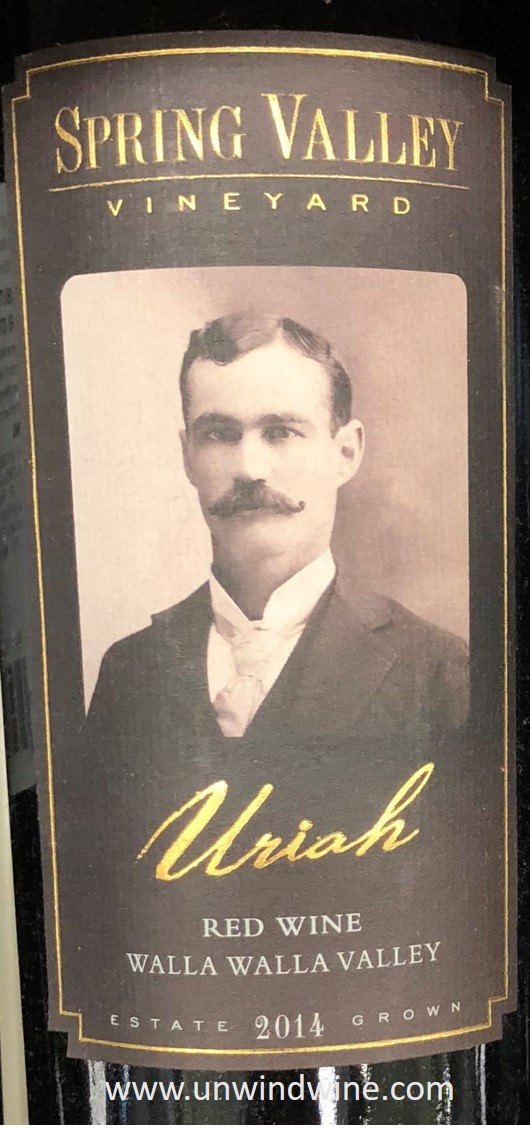
Spring Valley Vineyards Uriah Red Blend 2014

For the main course of filet of beef we opened this Right Bank Bordeaux varietal blend from one of our favorite producers. We've written often in these pages about Spring Valley Vineyards in Walla Walla Washington and their portfolio of wines named for members of the family. 

We've written a dozen tasting notes about this label, but surprisingly, this is the first one for this 2014 vintage release.

Spring Valley Vineyard Uriah is a Right Bank Bordeaux Blend, meaning it is Merlot based like those from the northeastern or right bank of the Gironde River, (as opposed to. Spring Valley Frederick, their Left Bank Bordeaux Blend in the style of wines from the left bank or from the south west of the river based primarily on the Cabernet Sauvignon grape.) 

I've featured in these pages often about the portfolio of Spring Valley wines with each label featuring a member of three generations of the Corkrum family reaching back to first generation founding producers Uriah and wife Nina Lee.

We tasted and acquired this wines during our visit to the tasting room and vineyards during our Spring Valley Vineyards Tasting and Vineyard Visit as part of our appellation visit to the Walla Walla (Washington) wine region in 2018. 

During our visit to the area, we drove out northeast of town to see the Spring Valley Vineyards. 

There we had the privilege of meeting Dean Derby, husband of Sharilee Corkrum Derby, who is daughter of Frederick and grand-daughter of Uriah Corkrum who is featured on this label. 

Tonight, with dinner,  Linda also served a chopped salad, a selection of artisan cheeses and medley of Greek olives. The black Greek olives were an amazing pairing with this wines.

Spring Valley Vineyard Uriah Walla Walla Valley Red Wine 2014

We've been collecting this label for two decades and typically hold close to a decade of vintages in our cellar. When the 2010 vintage received a Top 100 #27 in the Wine Spectator Top 100 ranking for the year, it suddenly disappeared from merchant stocks.
We acquire it regularly as part of our wine club shipments allocation.

Tonight, this 2014 vintage is the oldest release we hold in our cellar of this wine so we pulled it as part of cellar management, drinking the oldest vintage as we cycle through the half dozen vintage releases in our cellar, replacing the oldest with the newest.

Being a blend of five Bordeaux varietals, this was more complex than the 'simpler' Frederick with only three. I often compare the profile of blended wines to their width and depth - imagine a bar chart with five bars vs one with three.

This 2014 release of Uriah is a blend of 56% Merlot, 38% Cabernet Franc, 4% Petit Verdot, and 2% Malbec

This release was awarded 93 points by Wine Spectator and James Suckling, 91 points by Wine Enthusiast, and 90 points by Robert Parker's Wine Advocate.

Winemaker's notes - "Winemaker Notes A blend focused on elegance and finesse. Herbal nose with hints of cassis and cherry. Lightly spiced, the texture is rich with velvety tannins and an ultra-long finish."

Interesting that back on release, Wine Spectator wrote to "Drink now through 2023". At ten years of age, I would say this was at the apex of its drinking profile, not likely to improve with further aging,

Dark ruby colored, medium full bodied, concentrated,  complex, a bit tightly wound but balanced, dark berry, cherry and plum fruits with notes of herbs, black tea, dark mocha chocolate with hints of creosote with nicely textured and integrated acidity. 

RM 92 points.

https://www.cellartracker.com/wine.asp?iWine=2296582

https://www.springvalleyvineyard.com/

Some other Uriah reviews going back a dozen years ... 

https://unwindwine.blogspot.com/2021/05/spring-valley-2013-blends-uriah-vs.html

https://unwindwine.blogspot.com/2023/02/uriah-spring-valley-red-blend-2015.html

https://unwindwine.blogspot.com/2019/03/uriah-spring-valley-vineyard-red-wine.html

https://unwindwine.blogspot.com/2018/09/uriah-spring-valley-vineyards-walla.html

https://unwindwine.blogspot.com/2016/12/spring-valley-vineyard-uriah-red.html

http://unwindwine.blogspot.com/2015/07/uriah-spring-valley-red-blend-2002.html

http://unwindwine.blogspot.com/2015/02/del-dotto-gio-tuscan-reserve-spring.html

http://unwindwine.blogspot.com/2014/09/groth-reserve-napa-cabernet-2010-on-eve.html

http://unwindwine.blogspot.com/2013/12/spring-valley-vineyard-uriah-walla_19.html