Showing posts with label GSM. Show all posts

Sunday, September 6, 2026

Labor Day cookout smoked beef brisket and premium reds

End of summer brought family gala Labor Day cookout featuring smoked beef brisket and medley of premium red wines …

Most of the family gathered at son Ryan’s and Michelle’s for a gala end of summer Labor Day cookout. Ryan smoked a beef brisket and opened from his cellar a selection of ultra-premium red wines. 

Everyone brought a salad, side dish or dessert to accompany the brisket and grilled hot dogs. 

Ryan pulled from his cellar a diverse horizontal (multiple bottles from the same vintage) selection of 2005 vintage ultra-premium red wines from Napa Valley, central California Paso Robles and Left Bank Bordeaux. 


Phillip Melka Métisse Red Wine 2005

This is from one of our favorite producers, Phillippe Melka, a producer we know well and hold several of his labels across two decades of vintages. Phillippe was the mentor for Eric White of Galena Cellars Vineyards and Winey in Galena, IL, whom we met during our stay in the estate guest house during our getaway holiday week a couple years ago. 

Philippe grew up in Bordeaux, earned his degree in Geology at the University of Bordeaux and later his Master’s degree in Agronomy and Enology. His first wine job was at Château Haut Brion in Bordeaux. His first introduction to the Napa Valley came in 1991 as an intern with Christian Moueix, proprietor of Chateau Petrus in Bordeaux and Dominus in Napa Valley. Philippe came to Dominus to study soils – then spent a few years as a traveling winemaker and ultimately settled in the Napa Valley in 1994. The list of Napa wineries that Philippe has worked with over the years reads like a whose who list of the valley – Alejandro Bulgheroni Estate, Brand, Bryant Family, Dana Estates, Lail, Hundred Acre and Tusk Estate among many other well-regarded brands.

Philippe works with co-proprietor and co-winemaker for Melka Estates, wife, Cherie Melka. Cherie earned a degree in Microbiology at Northern Arizona University and worked for a while in pharmaceuticals as a laboratory technician. In 1989, she moved to California and took her first winery job for Paul Draper at Ridge Vineyards where she ran the lab for five years. It was here that she met Philippe who was working the vineyards. Cherie was self-taught as a enologist gaining her wine knowledge from equally impressive estates such as Ridge Vineyards, Beaulieu and Silver Oak Cellars. 

Their combined science backgrounds and extensive experience in the industry made them a perfect team in their winemaking endeavors.

The Melka brand started in 1996, when Philippe and Cherie moved back to Napa Valley from France and set out to produce their own brand, despite each working for different wineries.  After years of consulting, Philippe and Cherie opened up Melka Wines, in 1996, celebrating their first vintage of a Bordeaux styled Red Wine labeled Melka Métisse with a total production of 500 cases. 

Melka Estates started with Philippe and Cherie Melka sourcing fruit for their first two labels, two wines, one named in honor of their two children Chloe and Jeremy, and Métisse. They have since grown to four collections, CJ (a red blend very approachable in its youth sourced from premium vineyards throughout the Napa Valley), Métisse (a word that means ‘blend of cultures’ with wines from the Napa Valley), Mekerra (from the property they own in Sonoma County) and Majestique (single vineyard wines from outside of the Napa Valley). As a footnote, one quickly realizes the affinity the Melka’s have for the letter ‘M’.

The vineyards that contribute to the making of Melka wines are sourced from relationships with growers over the 20 years that they’ve been making this wine. Two primary sources of fruit for CJ are Soda Canyon, a unique area in Napa Valley near Oakville with hillside fruit, and Broken Rock has brought more fresh crushed rocks, good acidity and more massive tannins.

We’ve held this label dating back to that inaugural vintage release in 1996. 

This 2005 Melka Métisse Proprietary Red is a full-bodied, elegant Napa Valley Bordeaux blend.

It is a comprised of 92% Cabernet Sauvignon and 8% Petit Verdot, 100% sourced from the Jumping Goat vineyard in St. Helena.

It’s was aged 19 months in French oak barrels (75% new). Production was 475 cases.

This was rated 94 points by Int'l Wine Cellar and 93 points by Wine Spectator and 91 by Wine Advocate.

Dark ruby colored, medium to full-bodied, intense, concentrated, complex, ripe blackberry and black currant fruits with notes of spice, cassis, licorice, tar, spices and bitter mocha chocolate with smooth polished tannings on a lengthy finish.

RM 93 points.  


Chateau Montrose St Estephe Bordeaux 2005

This is a classic left bank Bordeaux from a classic vintage that should last several decades and at twenty years is just beginning to reveal its true profile and potential. In 2024, Jeb Dunnock wrote, “ (this) Montrose has another 50-75 years of overall longevity. It should cruise for another 30 years in cold cellars“ 

“It’s just now starting to show a kiss of maturity and it looks to be in the early phases of its prime drinking window. It’s also the finest bottles I’ve had, pointing to this starting to round the corner and show its full potential.” 

It is being written that the 2005 will, at maturity, surpass the two classic vintages of 1989 and 1990 - high praise signaling a top vintage with extraordinary aging potential. 

We’ve collected this classic old school St Estephe label going back to the early 1980’s, including our kids’ birthyears, 1981’ ‘82, ‘85 and 1990. We still hold several vintages dating back to the 1980’s. 

This was the final vintage managed entirely by the Charmolüe family before the estate was sold to the Bouygues in 2006. 

We drove by the historic St Estephe estate along the Gironde River just north of the town of Pauillac during our visit to the region in 2018. 


The 2005 Montrose is classic St Estephe, old school, a behemoth wine with a massive Cabernet profile, big bold dark cassis, hints of pencil cedar shavings, and earthy and leathery aromas and tobacco just starting to reveal, big ripe fruits with great tannic and acidic structure. 

This highly acclaimed release was rated 99 points by Jeb Dunnuck, 98 points by Jane Anson of Robert Parker's Wine Advocate and The Wine Independent, and 96 points by Decanter, James Suckling and Neal Martin for Vinous. 

This is a blend of 65% Cabernet Sauvignon, 31% Merlot, 3% to 3.5% Cabernet Franc, and 0.5% to 1% Petit Verdot. It was aged in 60% new oak. The winemaker was Jean-Bernard Delma who oversaw the elevage of this wine. 

Jeb Dunnuck wrote in 2024, “It’s just now starting to show a kiss of maturity and it looks to be in the early phases of its prime drinking window. It’s also the finest bottles I’ve had, pointing to this starting to round the corner and show its full potential.” 

Neal Martin of Vinous wrote, “It's no shy retiring flower by a long stretch—if you seek a more bombastic Montrose then this is where to come. "

Winemaker Notes - “2005 impresses by its exceptional power, the amazing pure fruit, and the extraordinary engaging elegance without having the overwhelming charm of the 2003. Stylistically, very classical and very Bordeaux-like, without austerity. Dense purple color, almost black.The nose is still closed: black fruits, spices, chocolate. Complex palate, long, rich, powerful, cherry, cocoa, licorice, tobacco brown, prune. This is a very big wine, full and very structured, with nice length, the tannins are very robust, with great aging potential.”

As with many super highly rated wines, this shows a characteristic profile revealing a flawless lack of faults, with a terrific sense of freshness, balance, and remarkable purity and precision. 

Dark garnet, ruby/plum-hued, full-bodied, intense, dense, concentrated, complex, yet balanced, still a bit tight and closed, layered dark blackcurrant and red fruits, spices, cloves, chocolate loamy soil, leather, graphite and hints of black truffles, floral and ash, turning to refined, silky polished tannins, on a long elegant finish. 

Be patient, give this time, and hopefully if you’re lucky and able, taste periodically over an extended period to see how it matures, opens to reveal itself  

RM 95 points.

https://go.cellartracker.com/wine/222327 


More to come …. 

Saxum Broken Stones Red Wine 2005

This limited release highly allocated label is a blend of 74% Syrah, 24% Grenache, and the rest Mourvèdre, what is commonly called a “GSM” in Australia and other parts where this southern Rhone Valley blend is common.  

This is produced by Heather and Justin Smith whose family owns the James Berry Vineyard, one of the rare sites in Paso Robles on limestone. They produce ultra-premium wines under the Saxum Vineyards label.

Saxum Vineyards is located in the Paso Robles AVA of Central California was founded in the early 2000s by Justin Smith, a young winemaker who had previously been part-owner of Linne Calodo.

Saxum gained notoriety in late 2010 when its 2007 James Berry Vineyards wine was named the #1 Wine of 2010 by Wine Spectator. The wine is a Rhone-style blend of Grenache, Mourvedre and Syrah. 

Saxxum are part of the community of producers in Central California Coast that have become known as the “Rhone Rangers,” because they specialize in Rhone Valley-style blends. 

The intense sunshine and relatively steep and rocky terrain of the Paso Robles AVA, which was officially recognized in 1983, is similar to the terrain of the Rhone Valley. 

The Paso Robles AVA is midway between San Francisco and Los Angeles, and it is considered one of the West Coast’s most exciting winemaking regions. Located in San Luis Obispo County, Paso Robles, the town and its surrounding area, was traditionally a farming and ranching region. With its hot, sometimes searingly dry and sunny weather, it is especially good country for growing warm climate grapes such as Syrah, Grenache and Mourvedre. 

So many Paso Robles wineries have been successful with blending these grapes into Rhone Valley-style wines, it is known as the Rhone zone of California. 

There are 32,000 vineyard acres in the Paso Robles AVA that was created in 1983. In late 2014 the AVA was divided into 11 smaller sub-appellations, so, starting with the 2015 vintages, Paso Robles wines are label with more specificity, which will now also list sub-appellations. 

Today there are more than 200 wineries.

Smith and his wife Heather owns the winery with the James Berry Vineyard,  the Smith family’s estate vineyard, located 10 miles from the Pacific Ocean with an average elevation of 1200 feet. It consists of a series of slopes with shallow clay loam topsoil covering an ancient seabed, complete with fossilized shells and sharks teeth.

Smith planted several othertop vineyards in Paso Robles while mentoring a number of his colleagues. 

Heather and Justin produce under the label Saxum Vineyards and focus on producing Grenache, Syrah, and Mataro based blends from the Willow Creek District of Paso Robles.

Their vineyards have the unique terroir of rocky calcareous soils, steep hillsides, sunny days, and cooling ocean breezes. They produce wines keeping yields low, picking the fruit at the peak of ripeness, and using a minimalist approach in the cellar. 

The vine’s roots penetrate deep through the fissures in the calcareous soil so that irrigation is rarely needed. Production is kept around 8000 cases a year divided between twelve different cuvees, Broken Stones, James Berry Vineyard, Hexe, Bone Rock, Rocket Block, Somnus, Cayucos Ridge Vineyard, G2 Vineyard, Paderewski Vineyard, Heart Stone Vineyard, 4hearts Vineyard, and James Berry Vineyard White.

The limited release Broken Stones bottling is sourced from all of the vineyards in the Saxum lineup. The Broken Stones cuvee is Syrah based, with a large portion of Petite Sirah and Grenache and a splash of Mataro. It is aged for 18-20 months in mainly new, French barriques. 

This label was rated 94 points by Wine Advocate and 91 points by Vinous. 

Winemaker notes - It is full-bodied, rich, and intense, but also reveals great purity, focus and complexity. The Broken Stones is a multi-vineyard blend, utilizing all the vineyards that we source from. Our wines are never racked off their lees and are bottled unfined and unfiltered.”

It boasts dark garnet colored, full-bodied, opulent wine with notes of licorice, forest floor, pepper, spice box, and loads of black and red fruits that saturate the palate with crisp acidity, heady alcohol, and loads of flavor, depth, and richness.


Ryan then pulled from the cellar one of my favorite wines that is drinking optimally right now….

Odette Napa Valley Stags Leap District Cabernet Sauvignon 2019

This wine was a highlight of another recent dinner as well as one of our Pour Boy’s wine group dinners last year. I wrote about that dinner and tasting and this producer label in these blogposts - OTBN 2025 in Charleston - https://unwindwine.blogspot.com/2025/02/otbn-2025-in-charleston.html, and Christmas revelry includes ultra-premium wine flight - https://unwindwine.blogspot.com/2024/12/christmas-revelry-includes-ultra.html, excerpted here.

As noted in that post, this is from the Odette 45-acre estate vineyards in the heart of the Stag’s Leap District appellation nestled against the foothills on the east side of Silverado Trail just north of Napa town. 

It’s too bad this label is part of the Plumpjack Group with their unfortunate affiliation with Gavin Newsom. Never-the-less, despite the distractions and mis-directions, they produce some fabulous wines. 

This release was crafted by Odette winemaker Andrew Haugen.

A native from Southern California, he studied biology at Cal Poly in the Central California wine region around San Luis Obispo. There, he also took the available wine classes. Pursing his interest in wine, he gained experience at Stonestreet in Sonoma County for his inaugural 2012 harvest, then at Church Road Winery in New Zealand, Howard Park in Australia, and Gran Moraine in Oregon’s Willamette Valley, before joining Odette Estate Winery in 2015.

From that time he progressed from cellar master to enologist to assistant winemaker and eventually head winemaker for the Odette and their Adaptation labels. He works closely with long-time Vineyard Manager Oscar Renteria at Oso Vineyard, and a 129-acre site located in Pope Valley.

Odette Stag’s Leap District Cabernet Sauvignon 2019

This is part of the Plumpjack group portfolio of wineries. We used to love their wines. I wrote about Plumpjack and their unfortunate demise into woke progressive politics in this recent blogpost - Plumpjack Estate Napa Valley Cabernet for meatloaf dinner, and in previous posts, Plumpjack Founders Reserve Cabernet, and Spectacular dining experience at Entourage Restaurant Downers Grove. in more detail in this recent blogpost. 

Odette Estate Winery was established in 2012, sitting on 45 acres straddling the Silverado Trail in the Stag’s Leap District in southeast Napa Valley. It was founded with a guiding philosophy of environmental responsibility and a commitment to preserving their special spot in the Stags Leap District for generations to come.

The winemaker for Odette is Andrew Haugen who gained interest in wine with the movie Sideways during his time at Cal Poly San Luis Obispo. He set out to deepen his knowledge, with his fascination with relationship between ‘site and soul’ in wines. Andrew joined the Plumpjack/Odette team in 2015 as Cellar Master, honing his skills and ascending to Enologist, Assistant Winemaker, and now Head Winemaker for Odette and also sister winery estate, Adaptation.

This release is actually a blend of Bordeaux varietals- 84% Cabernet Sauvignon, 8% Merlot, 6% Malbec and 2% Petit Verdot. 

Bring a classic traditional Left Bank Bordeaux Blend explains why this wine was wider and more complex and not as deep, so to speak, when compared to the other Napa Cabs. This likely showed best when consumed with the beef tenderloin. 

This release was awarded 97 points by Jeb Dunnuck. 

Dark garnet colored, full bodied, round, complex, concentrated ripe blackberry, black currant and black raspberry fruits accented by crème de cassis, licorice with notes clove spice and anise with bright acidity and smooth polished fine grained tannins on the long persistent finish.

RM 92 points. 


Tuesday, July 28, 2026

Domaine Grand Veneur "Les Origines" Châteauneuf-du-Pape

Domaine Grand Veneur "Les Origines" Châteauneuf-du-Pape With BBQ Ribs 

Following our BBQ rib dinner the other night, we had leftover ribs with baked potato and sweet corn. Then, we enjoyed the BBQ with a favorite wine pairing, a bold Aussie Shiraz which we featured in this blogpost - Branson Coach House Greenock Block Shiraz with BBQ Ribs.


Tonight, I pulled from the cellar a vintage aged CDP - Châteauneuf-du-Pape, in accordance with appellation rules, a Rhone varietal red blend. This release is what is known as a ‘GSM’, a blend of Grenache, Syrah and Mourvèdre, the three grapes required to comprise at least 70% to be designated a CDP. This is another one of our favorite food and wine pairings - that same Syrah/Shiraz as the Aussie varietal, but as part of a blend. 

We visited the appellation in 1999 and again in 2018 - chronicled in these posts - A visit to Château La Nerthe, and Domaine du Vieux Télégraphe. Châteauneuf-du-Pape.

Domaine Grand Veneur "Les Origines" Châteauneuf-du-Pape 2005 

Domaine Grand Veneur "Les Origines" Châteauneuf-du-Pape is produced by Alain Jaume & Fils a highly acclaimed family owned and operated estate, founded in 1826 by Mathieu Jaume, and then succeeded by Marius, Fernand and Roger Jaume.

In 1979, the current generation ancestors Odile and Alain Jaume and his two sons continued the family tradition with the creation of "Domaine Grand Veneur". 

At the outset, the vineyard covered 22 and a quarter acres, and was expanded over the years such that today, Domaine Grand Veneur is a 170-acre estate based in Châteauneuf-du-Pape, in the Southern Rhone Valley. The estate is at the northern edge of the appellation on the southernmost outskirts of the city of Orange. 

In addition to the family’s vineyards in Châteauneuf-du-Pape, they also have parcels in Cotes du Rhône and Lirac, the appellation on the other side of the Rhône River. Grand Veneur produces red and white wines, and the family also has a negociant business called Alain Jaume & Fils. Robert M. Parker Jr. has called Grand Veneur “one of the best run estates in Châteauneuf-du-Pape.

The cellars were built just outside of the town of Orange at the top of the appellation, on the road to Châteauneuf du Pape to the south. 

A Châteauneuf-du-Pape Appellation designated wine from the Southern Rhône Valley, CDP wines are a blend with up to thirteen specified grape varieties allowed, but typically ~50–55% Grenache, 30% Mourvèdre, and 15–20% Syrah, with 70% required from these three grapes. 

The 2005 release is a blend of 55% Grenache, 30% Mourvèdre and 15% Syrah that saw 16 months in 55% concrete tank and 45% in smaller barrels. 

While the Vieilles Vignes bottling wasn’t made until 2006, the 2005 Châteauneuf du Pape Les Origines goes all the way back to 1998. The Les Origins bottling is comprised of fruits from the oldest blocks in the estate vineyards, sourced from old vines over 65 years old, grown in the red clay and deep gravel soils typical of the Rhone Valley. 

We hold a half dozen releases of this label dating back to the turn of the century, this being the current oldest of our collection, selected accordingly as part of cellar inventory management.

This release was rated 95 points by Robert Parker’s Wine Advocate, 93 points by Wine Spectator, and 92 points by Vinous. 

In their 95 point review in 2015, Wine Advocate wrote “It freshens up in the glass, and while drinking nicely now, will have no problems evolving gracefully for another decade.” 

So here we are … at age 21 the label, foil and most importantly the fill level and cork were still in pristine condition. 

For those folks that think Châteauneuf du Pape does not age, this is a top wine from a top vintage and at age 21, it is doing just fine and still has a few years left. Every once in a while you open a bottle and it’s at peak. This was one of those times - the benefits of having a cellar and aging wines.

Deep ruby in color, medium to full bodied, full round expressive complex but nicely integrated black berry and black cherry fruits, notes of tobacco, spices and leather, with hints of licorice and garrique, lacking the typical black pepper sprites, with subtle smooth dusty tannins on the long, sweet, pleasant lingering finish. 

RM 92 points. 


Friday, September 13, 2024

Pour Boys tenderloin and big red wines dinner

Our Pour Boys wine group gathered in Chicago for the gala fall CityScape Dinner hosted by Lyle and Terry. Bill and Beth C traveled in from Charleston and stayed with us for the weekend. 

For Friday night dinner, Linda prepared a grilled beef tenderloin with peppercorn sherry sauce, haricot verts, grilled vegetables and baked potatoes. 


For a wine accompaniment with the dinner, Bill and I trolled our cellar and pulled two aged vintage Napa Cabs of which we have visited the producer estate together. 

Prior to dinner we had a cheese board with a broad selection of artisan cheeses, fresh sesame bread and assorted crackers/biscuits, and wedge salad with blue cheese. 

Cheeses - 

  • Aged Cheddar
  • Aged Sharp Cheddar
  • Gorgonzola with chive
  • Aged Blue Cheese 
  • Smoked aged Gouda
  • White cheese with dill 


With the cheese course, and for the ladies preference, we opened a Tensley Syrah Grenache Rhône Valley varietal blend from Santa Maria Valley.

Tensley 'All Blocks' Tensley Vineyard Santa Barbara County Red Wine (GSM) 2020

We discovered Tensley and their Santa Barbara County Wines including this label during our visit to their estate and then their tasting room during our Santa Barbara County Wine Experience in 2022.

Winemaker Notes: "Exclusively from Tensley and Colson Canyon Vineyards, this blend of Grenache, Syrah and Mourvedre (GSM) is very complex and full of texture.'

"The Grenache brings red fruit and finesse, Syrah imparts riper black fruits to the blend, and the Mourvedre rounds out the complexity with savory notes and tannic structure. A wine built for enjoyment, super complex but juicy and round for easy drinking."

540 Cases Produced

This was awarded 93-95 points by Jeb Dunnuck and 95 points by Wine Advocate.

https://www.cellartracker.com/wine.asp?iWine=4266214

https://tensleywines.com/

Arns Napa Valley Cabernet Sauvignon 2000

We visited the Arns estate and vineyards on the lower reached of Howell Mountain in 2013 - Visit to Arns Napa Valley Estate Vineyards.

Rick, Linda and Bill with producer John Arns


Arns Napa Valley Cabernet Sauvignon 2000 

We hold numerous vintages of this label in our cellar collection and have chronicled the producer and several vintages of this label in these pages. 

At twenty four years, the foil, label, and most importantly, the fill level and cork were in ideal condition. 

Starting to show its age with some slight bricking, this is starting to reach the end of its drinking window and should be consumed in the next couple of years. 

Garnet colored, medium full bodied, balanced, round full black berry and plum fruit flavors with notes of cassis, black tea, tobacco and hints of cedar with nice balance of tannin, fruit, and acidity w/ mild oak influence with a long finish.

RM 91 points. 


David Arthur Napa Valley Cabernet Sauvignon 2004

That same Napa Valley Wine Experience, we also visited David Arthur Napa Valley Estate Vineyards and Winery, located on Pritchett Hill in the Vaca Range at the bottom of Napa Valley, overlooking the City of Napa. 

Like the Arns above, we hold several vintages and labels of David Arthur and have covered the producer and numerous vintages of this label in these pages. 

David Arthur Napa Valley Cabernet Sauvignon 2004

Like the Arns above, at twenty years, the label and foil, and most importantly the cork and fill level were ideal. But, this vintage release is still at the apex of its drinking profile, and while not likely to improve any further with aging, should age gracefully for up to another decade or more. 

I like this wine as noted that the first time I posted a tasting note of this label was on my birthday back in 2013, when I wrote:

This is as expressive as any David Arthur Cabernet I have tasted to date. It explodes with sweet ripe plum and berry fruits, accented with tones of dark chocolate and a layer of caramel turning to hints of anise, spice notes of tobacco and sweet spicy oak and moderate tannins on the lingering finish. 
RM 92 points.

Tonight’s tasting was consistent with that earlier review. 

 https://www.cellartracker.com/wine.asp?iWine=2065630

https://www.davidarthur.com/

Wednesday, February 7, 2024

Destiny Neighborhood Beef Tenderloin Wine Dinner

Destiny Neighborhood Beef Tenderloin Wine Dinner

Visiting our favorite getaway Destiny Cove vacation rental in Destin, Florida, we hosted a dinner with friends and neighbors. Linda prepared a full beef tenderloin, sliced into filets of beef, served with baked potatoes, haricot verts and mixed green salad. 

Before dinner we served a variety of artisan cheeses, fruits and mixed nuts. 

To accompany the dinner we opened a wine flight with varietal wines for each course. 

With the salad course we served a Washington State Chardonnay. 

With the main course we opened a medley of red wines - an aged vintage Napa Cabernet, an aged simple easy drinking Sonoma Cabernet, and a complex Washington State GSM Blend. 

Our guests brought for the dessert course a selection of artisan cupcakes from the bakeshop just outside our community gate and carrot cake cupcakes, which we paired with a flight of dessert wines from Italy and Austria.

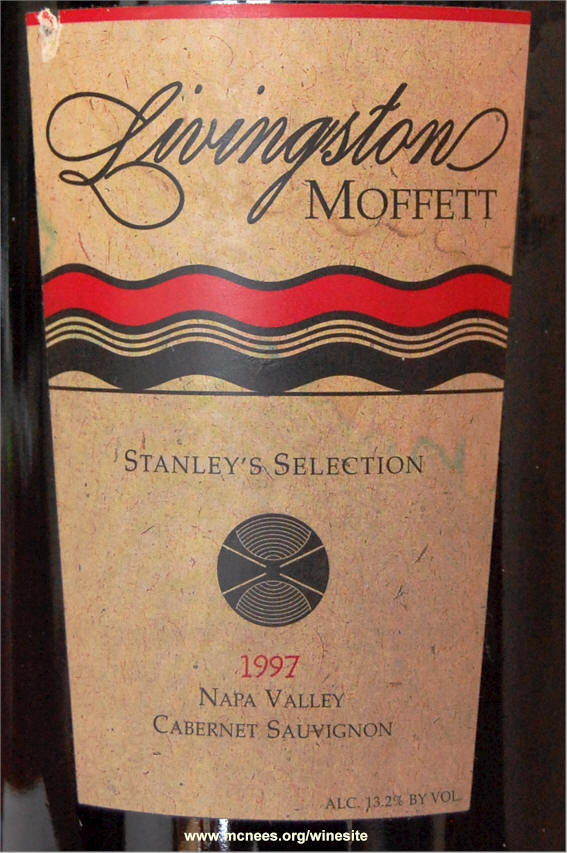
Moffett Livingston Stanley's Vineyard Napa Valley Cabernet Sauvignon 1997

We were planning a mini-family reunion last month in Destin so I brought for that occasion several 'family' wines, whimsically sharing names with certain family members, such as this Stanley's Vineyard label and so named brother-in-law.

This is named for 'Stanley', a family name in the owner/producer John Livingston's family. John resettled his family in St. Helena, Napa Valley in 1976 as an idyllic place to raise his six children, not necessarily with any forethought of joining the wine business. However, in 1984, they began pursuing their learned passion in wine and began producing Cabernet wines.

John Livingston was a geologist, and became intrigued with finding vineyards suitable to produce Stanley’s Selection Cabernet wine, seeking an optimum combination of stony hillside soils, eastern exposures and suitable micro-climates. In the ensuing years he found such vineyards, also chosen for sound farm management and proven consistency. All the vineyards were only a few acres in size, too small for big wineries but perfect for Livingston Stanley Cabernet. The 'Stanley’s' Vineyard label was blended from six small parcels in Napa by legendary winemaker John Kongsgaard.

Moffett Vineyards and the Livingston Moffett Winery, continued to be operated by Diane and John Livingston and were assisted for 22 years by their son Trent who helped grow the family winery from the cellars to the marketplace. Diane and John retired and sold the winery in 2005, resulting in a generational transition with Trent as successor of Moffett Vineyards.

Trent and his wife Colleen Moffett relocated in 2014 to the northern Willamette Valley to pursue making 4 different Pinot Noirs from 3 different Willamette Valley sub-appellations, all the while remaining connected with Napa Valley through Moffett Vineyards.

In addition to the Moffett Vineyards heritage, Trent and Colleen are co-producers of Screenplay Wines and C&T Cellars. .

This is the last of three bottles we acquired back upon release. We drank the first two bottles back in 2010 and 2014 and still held this bottle a decade later in our cellar. 

At two and a half decades, this was still holding its own, only perhaps slightly diminished from age at a quarter century, testament to the longevity of the ‘97 vintage Napa Cabs.  

This release was awarded 93 points by Wine Enthusiast and 90 points, Wine Advocate, Robert M. Parker, Jr. Upon release, Parker said it should drink well for fifteen years.

Winemaker's notes - "For the 1997 vintage, John chose four mostly one- to two-acre vineyards: Price, next door to Spottswoode; Walther, near Caymus; Corbett, adjacent to Moffett Vineyard; and Gemstone, with five clones of Cabernet along with Cabernet Franc, Merlot, and Petite Verdot. Yields ranged between of 2.5 to 4.5 tons per acre. It was aged in a combination of French and American oak."

Tonight, this was largely consistent with my earlier tastings, dark ruby colored, medium bodied with blackberry, black cherry and currant fruits, starting to give way slightly with notes of black tea with hints of anise and bitter dark chocolate with a bit of spice, plum with tone of cedar on the medium to firm tannins and acid balanced finish.

RM 89 points. 

https://www.cellartracker.com/wine.asp?iWine=162762

http://moffettvineyards.com/

https://unwindwine.blogspot.com/2014/12/livingston-moffet-napa-cab-with-beef.html

Another label we were holding for our bro-in-law, a fan of the namesake producer, we opened this for casual drinking with cheeses, fruit and nuts before dinner. 

Dan Aykroyd Discovery Series Sonoma County Cabernet Sauvignon 2007

This was a futile inglorious attempt at producing a novelty namesake branded wine by comedian and Saturday Night Live fame Dan Aykroyd, who folks say, should've stayed with acting.

Winemaker Notes - "The grapes are sourced primarily from the Alexander Valley, which with its cool mornings and evenings and warmer inland climate allow the Cabernet Sauvignon grapes to fully ripen. The wine is aged in 60-gallon French, American & Hungarian oak barrels for added complexity and increased concentration. This process also brings out softer tannins and a more fruit-forward palate."
 
Cellartrackers panned this wine, albeit they tend to be sophisticated wine drinkers. This exceeded my expectations, which admittedly were very low. I was open minded and opened it prepared to dump it, but while simple and uninspiring, it was okay for casual sipping with some cheeses before dinner. Several guests found it enjoyable and suitable for casual easy sipping.

Wine Enthusiast gave this 82 points. I didn't find it resembled their profile - "Overripe and bitter .... dry, with raisin and grapeskin flavors that have a Porty, tannic edge."

Ruby colored, medium bodied, dark berry fruit, notes of tobacco, smoke and black tea with an abrupt finish. RM 82
 
https://www.cellartracker.com/wine.asp?iWine=649869
 
With the dinner we opened this Rhone varietal red blend. 
 

Force Majeure "Parvata" Red Mountain GSM - Grenache, Syrah and Mourvedre 2017


We've opened this wine and featured it several times in these pages. We first featured this label in our Force Majeure Vineyards Site Visit and Tasting report as shown here:


October 2018

Force Majeure Vineyards Site Visit and Tasting

Force Majeure Vineyards Site Visit and Tasting

One of the inspirations for and objectives of our Walla Walla Wine Experience 2018 was to visit Force Majeure vineyards. We first met Force Majeure winemaker Todd Alexander and marketing, distribution and branding exec Carrie Alexander during the Chicago stop of their promotion tour in 2016 when we hosted them at Italian Village in Chicago. Since then we've acquired a respectable collection of Force Majeure wines, hence, they were one of our shortlist priority visits when we planned our Washington State, Columbia Valley wine trip.

Force Majeure Parvata Red Blend 2017 

We originally discovered and acquired this label during our visit to Force Majeure in Walla Walla back in 2018. We hold three vintages of a mixed case from our wine club allocation orders.   

This is from their Force Majeaure Red Mountain Vineyard site in the central Columbia Valley. The Red Mountain site was the very first vineyard on the steep, rocky upper slopes of Red Mountain. Developing the Red Mountain estate vineyards involved carefully matching varietal and clonal selections and vineyard trellising and irrigation to the eight distinct soil types in the vineyard.

Parvata means “mountain” in sanskrit, and hence is the name for Force Majeure's southern Rhône style blend, grown in the sandy, loamy soils of the lower section of the Red Mountain vineyard.

Parvata is a a classic Rhone River Blend that the French, and in the new World, the Australians, call GSM, for the blend of the three Rhone varietals, (25%) Grenache, (23%) Syrah, and (42%) Mourvedre. 

But this 2017 Parvata is a blend of Rhone varietals, somewhere between a GSM (Grenache, Syrah, Mourvèdre) and a CDP (Chateauneuf-du-Pape of which 70% is typicall GSM, the total can be from a possible thirteen sanctioned varietals). This release is 42% Mourvedre, 25% Grenache, 23% Syrah, and 'lesser' varietals, 4% Cinsault and 5% Counoie - 100% sourced from the Force Majeure Red Mountain Estate vineyard.

We've posted blogspots of the 2015 and 2016 releases but this is our first tasting of the 2017 release. It seems to be less fruit forward than the earlier releases.  

This was consistent with those earlier tastings. Dark garnet colored, medium full bodied, this is black fruits accented by white pepper, dried herbs, leather and tobacco notes with bright lively acidity.

RM 92 points.

https://www.cellartracker.com/wine.asp?iWine=3519567

https://unwindwine.blogspot.com/2018/10/force-majeure-vineyards-site-visit-and.html

https://forcemajeurevineyards.com/ 

@ForceMVineyards 


We then served artisan cupcakes brought by neighbor Jan, and cupcakes brought by Debra. With the sweets, we opened several dessert wines from different regions with different profiles.

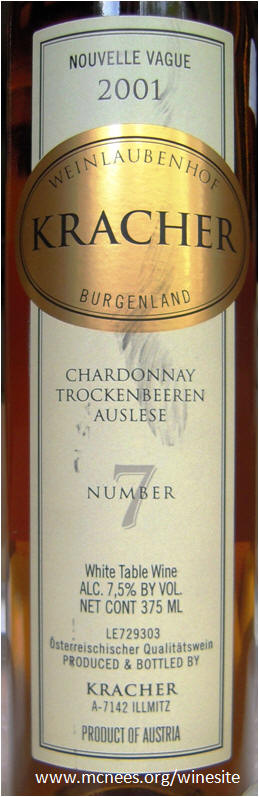
Alois Kracher Nouvelle Vague TBA - Trockenbeerenauslese Chardonnay No. 7 2001

We brought this from our home cellar and were holding it for a special occasion such as this. We hold a vast collection of labels and vintages from Kracher who offer a broad portfolio of dessert wines from Austria. This is from Seewinkel, an area in the Burgenland region of Austria, along the eastern shore of Lake Neusiedl,

Kracher is internationally regarded as one of the finest dessert wine makers. After Alois Kracher passed away in December 2007, his 27 year-old son Gerhard took over responsibility of winemaking and managing the winery. He carried on the tradition with the same veracity and dedication that his famous father once did with the same outcomes of extraordinary notable award winning wines.

Weinlaubenhof Alois Kracher estate vineyards possess a microclimate uniquely suited to the production of Beerenauslese and Trockenbeerenauslese wines. They have nearly 70 acres of vineyards planted with Welschriesling, Chardonnay, Traminer, Muskat Ottonel and Scheurebe.

This release was awarded 95 points by Wine Spectator, 94 points by Wine Enthusiast. and 18/20 points by Jancis Robinson.

Winemaker Notes - "Attractive aromas of ripe stone fruit, apricot jam, nuts and fresh herbs characterize this Welschriesling TBA, along with a silky texture and highly balanced acidity with pleasant floral notes on the elegant, salty finish."

In the fall of 2020 I wrote: "As I have written in the past, at their most desirable (to my taste preference) these wines are rich, thick, unctuous, and voluptuous with apricot marmalade, mango, toffee/brown sugar, and caramel notes. This may have been there at some point and perhaps passed that stage of its aging profile. If so, then it is time to drink although it will no doubt continue to age gracefully for several more years. But the rich, sweet apricot fruits nectar was diminished somewhat and has turned more to a smokey charcoal layer over the fruits which were more subdued. Delightful never-the-less

Copper and tea colored, full bodied, thick structured, rich concentrated notes of sweet orange marmelade, apple and apricot fruit nectar with of pain grille, honey and nutmeg spice on a long unctuous textured finish. 
 
In winter of 2018 - I gave this 91 Points.

https://unwindwine.blogspot.com/2018/11/thanksgiving-feast-features-rhone-wine.html

https://www.cellartracker.com/wine.asp?iWine=19086


Ca' della Vignalta Colli Euganei Fior d'Arancio Fiore del Deserto Moscato (Muscat) Passito 2015

From Veneto, and area formerly part of the Colli Euganei DOC, it was established as a separate DOCG in 2010. The Veneto DOCG appellation specifies some significant production rules: 

  • Grapes for Passito must be dried on or off the vine to achieve a minimum potential alcohol level of 15.5%
  • Minimum alcohol level: 4.5% for Bianco dolce (10.5% potential); 6.0% for Spumante (10.5% potential); 9.0% for Passito (15.5% potential); 10.5% for Bianco secco
  • Residual sugar: Minimum 100 g/l (10.0%) for Bianco dolce, Spumante, and Passito
  • Aging: For Passito, minimum 1 year (ERD = November 1, V+1)
Az. Agricola Vignalta Fior d
' Arancio Colli Euganei have 346 acres of vineyards on the side of the highest of the Euganean hills outside the village of Arquà Petrarca southwest of Paduea, Italy, seventy kilometers southwest of Venice. They are planted primarily to Moscato as the principal White Grape Variety, with an average age of vines of 16 years.  The grape is particularly suitable for the production of complex and intensely aromatic Passito wines that perfectly pair with desserts and biscuits. They produce 76,700 cases per year of which 5.000 – 7.000 bottles are this Orange Muscat based Passito, produced in 375 ml bottles.

Az. Agricola Vignalta produce a wide portfolio of red, white, dessert and sparkling wines. This sweet muscat wine is predominantly based on Moscato Giallo grapes, which produce sweet and fresh wines, with distinguishing citrus notes. The label includes three different styles: dry white wine, sweet Passito, and bubbly spumante.

Fior d ' Arancio Colli Euganei Passito DOCG : it is a complex wine, with a bright golden yellow color that reaches light amber with time. It reveals aromas of yellow fruit in syrup, apricot and acacia honey. It manages to maintain a good balance between flavor and sweetness.

Winemaker notes -  "With its amber yellow colour and golden reflections, our Fior d’Arancio Passito captures at first sight thanks to the bright shades that it shows in the glass. The perfume is complex and elegant: balsamic notes of canned fruit, dry dates, candied figs, jams, honey, eucalyptus and vanilla stand out from the bouquet. Each sip is warm, embracing but not cloying and has a delicate almond husk final taste. Rich and balanced. Vinification: drying grapes in “fruttaio” for 4 months, crushing and squeezing rasin to obtain a very sweet must, fermenting in French oak barrel for 18 months."

Descriptions of the color of these wines vary based on the age and stage of their aging profile. These dessert wines start out golden or pale straw colored, and darken over time, turning deep golden, then light brownish, darker to orange rust, then a copper color, and finally even to a blackish weak coffee color. High quality versions from top vintages can age for fifty years or more.  

Tea copper colored, full bodied, complex  sweet notes of figs, hints of honey, raisins almonds and sweet tea on a smooth pleasant finish.

RM 91.

https://www.cellartracker.com/wine.asp?iWine=2734338

https://www.vignalta.it/en/

Wednesday, February 15, 2023

Force Majeure Parvata Red Blend with Beef Bourgogne

Force Majeure Parvata Red Blend with Beef Bourgogne

Linda prepared a delicious hearty beef bourgogne stew and I wanted a proper wine to pair for the occasion - something big and bold, but not overpowering, and complex to meld with the breadth and depth of flavors. I chose this Parvata Rhone varietal red blend from Force Majeure for its complexity of the blend.

We first featured this label in our Force Majeure Vineyards Site Visit and Tasting report.

Force Majeure Parvata Red Blend 2017

We originally discovered and acquired this label during our visit to Force Majeure in Walla Walla back in 2018. We hold three vintages of a mixed case from our wine club allocation orders.   

This is from their Force Majeaure Red Mountain Vineyard site in the central Columbia Valley. The Red Mountain site was the very first vineyard on the steep, rocky upper slopes of Red Mountain. Developing the Red Mountain estate vineyards involved carefully matching varietal and clonal selections and vineyard trellising and irrigation to the eight distinct soil types in the vineyard.

Parvata means “mountain” in sanskrit, and hence is the name for Force Majeure's southern Rhône style blend, grown in the sandy, loamy soils of the lower section of the Red Mountain vineyard.

Parvata is a a classic Rhone River Blend that the French, and in the new World, the Australians, call GSM, for the blend of the three Rhone varietals, (25%) Grenache, (23%) Syrah, and (42%) Mourvedre. 

But this 2017 Parvata is a blend of Rhone varietals, somewhere between a GSM (Grenache, Syrah, Mourvèdre) and a CDP (Chateauneuf-du-Pape of which 70% is typicall GSM, the total can be from a possible thirteen sanctioned varietals). This release is 42% Mourvedre, 25% Grenache, 23% Syrah, and 'lesser' varietals, 4% Cinsault and 5% Counoie - 100% sourced from the Force Majeure Red Mountain Estate vineyard.

We've posted blogspots of the 2015 and 2016 releases but this is our first tasting of the 2017 release. It seems to be less fruit forward than the earlier releases. 

Dark garnet colored, medium full bodied, this is black fruits accented by white pepper, dried herbs, leather and tobacco notes with bright lively acidity.

RM 92 points.

The 2015 seemed to more fruit forward, more the style we love, with its dark blackish garnet purple colored, full bodied, rich unctuous concentrated black and blue fruits accented by white pepper and tones of dried herbs with bright lively acidity.

RM 93 points. 

https://www.cellartracker.com/wine.asp?iWine=3519567

https://unwindwine.blogspot.com/2018/10/force-majeure-vineyards-site-visit-and.html

https://www.cellartracker.com/wine.asp?iWine=2659538

https://forcemajeurevineyards.com/ 

@ForceMVineyards 

https://forcemajeurevineyards.com/wp/

Monday, November 21, 2022

Zaca Mesa Toyon Santa Ynez Valley Red Wine

Zaca Mesa Toyon a complex Santa Ynez Valley Red Wine Blend

I wrote earlier this week about receiving Zaca Mesa Mesa Reserve Santa Ynez Syrah, our Zaca Mesa Wine Club fall allocation shipment, and notes on tasting that first label from that shipment. Here is the second label and our tasting notes from that distribution. This was a great accompaniment to hearty Rosati's "Monster" pizza with spicy sauce.

Brambly bushes and shrubs around
Foxen Trail Vineyards
Zaca Mesa Toyon is a red blend wine named after a native shrub found growing in the sandy hills and terraces that surround the estate vineyards. Toyon (also known as California Holly and Christmas Berry) is a native evergreen that grows into a dense 10 feet tall and 8 feet wide drought-resistant shrub. Covered in leathery leaves all year, it blooms pretty, but unspectacular, white flowers in summer.

Zaca Mesa Toyon is a unique blend comprised of a combination of Santa Ynez Valley Rhône and Bordeaux grape varietals, sourced from fruit grown on and off the estate.

Zaca Mesa Estate Vineyard adjacent the winery
Writing about the unique combination of grapes in this label's blend,  Matt Kettmann of Wine Enthusiast called it a "kitchen sink blend".  He gave the 2016 release of this label 90 points.

The primary grape selection is akin to a Châteauneuf-du-Pape from the so named appellation in the southern Rhône River valley where the primary grapes required to be in the blend are G-S-M - Grenache, Syrah and Mourvedre. 

The GSM combination and so-called label is a popular blend released by many producers in Australia, California and Washington State - areas where Rhône varietals are grown. 

But Zaca Mesa take it a step further and adds the popular Bordeaux varietal grape Cabernet Sauvignon to the mix creating a complex wine that is somewhat a cacaphony of flavors, although the producer calls it a "seamless wine that is unlike anything else we produce".

Zaca Mesa Toyon Santa Ynez Valley Red Wine 2019

The actual blend consists of Shiraz/Syrah, Cabernet Sauvignon, Grenache, Mourvedre, and Cinsault grapes. Cinsault is another Rhône varietal. 
 
Actually, Châteauneuf-du-Pape appellation regulations allow thirteen different specified grapes in the blend, however at least 70% is required to be GSM - Shiraz/Syrah, Grenache, and/or Mourvedre.
 
Toyon 2019 was aged 19 months in neutral oak

I write in detail about the Chateauneuf-du-Pape appellation regulations in my blogpost on Our  visit to Châteauneuf-du-Pape and Château La Nerthe, back in 2019. Founded in 1936 when the decree of the appellation was published, Châteauneuf-du-Pape became the first wine-making Appellation-Origin-Controllee, AOC of France, which now governs all the major wine producing regions and has since been adopted in most major wine producing regions including Italy and the US. 
 
Indeed, the Bordeaux region alone has no less than 57 appellations that govern the viticulture and production required to bear the appellation seal of approval on the label. Napa Valley, America's premier wine growing region has seventeen officially designated appellations (AVA's) (See blogpost Mt Veeder Appellation and Winery Napa Valley Cabernet Sauvignon 2010.)
 
This was dark garnet colored, medium full bodied, complex, a cacophony of flavors with strawberry, black cherry currant and plum flavors with a layer of vanilla, accented by herbs, sweet tobacco and cinnamon spice, notes of earthy cedar and anise and a bit of pepper on a moderate tannin tangy acidic lingering finish.
 
RM 89 points. 

www.zacamesa.com

@zacamesawinery @zacamesa