Showing posts with label v1985. Show all posts

Sunday, May 31, 2026

Tomahawk Ribeye and Vintage Wines for Celebration dinner

Tomahawk Ribeye and Vintage wines for Celebration dinner 

We hosted son Sean and d-in-law Michelle and family for a mini-celebration dinner for a recent business and career milestone that will be announced soon. I pulled from the cellar a birthyear vintage bottle for both his and Michelle’s birthyears - two big reds to accompany the grilled tomahawk ribeye beefsteak. 

Linda also prepared sweet corn, roasted potatoes, a medley of mixed vegetables, and Sean prepared baby artichokes. 


Dunn Vineyards Napa Valley Cabernet Sauvignon 1985 

If you’re acquiring wines to commemorate a special vintage year for a future date, such as a birthyear, you select a producer with a track record for producing long lived wines, and select wine from a region that had a good harvest of quality fruit suitable for producing long-lived wines. 

Hence we hold a collection of such wines from Randy Dunn, the legendary, independent Napa Valley winemaker known for pioneering producing powerfull structured, age-worthy Cabernet Sauvignons. His 1985 Cabernet Sauvignon has shown longevity, maintaining incredible freshness and structure even four decades after harvest.

Randy Dunn helped shape the modern identity of Napa Valley. After studying enology at UC Davis, Dunn became the first head winemaker at Caymus Vineyards in 1975 where Caymus launched its legendary ultra-premium Special Selection Cabernet.

In 1978, Dunn and his wife Lori bought property atop Howell Mountain where he was instrumental in getting established the Howell Mountain AVA, which in 1983 became Napa’s first official sub-appellation.

While modern Napa moved toward micro-sorted, plush, high-alcohol wines, Dunn maintained his traditional style, crushing fruit with bits of stems intact for raw structure, and aging wines no less than thirty months in oak, crafting balanced, elegant, lower alcohol wines designed for the dinner table.

Dunn Vineyard’s Howell Mountain property is planted with 24 acres of Cabernet vines aging between 10-37 years.

We’ve written about Randy Dunn and select wines before in these blogposts -  

Dunn Vineyards and Caymus #40 Napa Valley Cabernet Sauvignons

Dunn Vineyards Napa Valley Cabernet Sauvignon 1999

We visited the Dunn Vineyards estate up at Angwin on Howell Mountain during our Napa Valley Howell Mountain Wine Experience back in 2008. We were hosted by Kristina Dunn that day but we had the privilege to meet winemaker, producer, patriarch and Napa Valley pioneer Randy Dunn. 

While not one of the larger holdings in our cellar in terms of number of bottles, it may be one of our broadest holdings in terms of number of vintages in our vertical collection of this label, and the flagship premium label Dunn Howell Mtn Cab.  We also collect Randy Dunn's "Feather" label that he produces for the Long Shadows Vintners Collection Series in Washington State

Our Cellartracker records indicate we have a vertical collection of several mixed cases of each label from almost two dozen vintages dating back to 1981. 

Selections from Vertical Collection of Dunn Napa Valley Cabernets

With Randy Dunn at Dunn estate high atop Howell Mountain.
Dunn is known for age-worthy long-lived Napa Cabernets, especially the premium Howell Mountain label.  Robert Parker tasted both Dunn labels at ten years of age in 1996 and wrote: "Two of the most impressive wines in these tastings, both of Dunn's 1986s tasted like 3-4-year old Cabernets rather than 10-year old adolescents.... Rich, pure, and youthful, this 1986 is accessible now, but will unquestionably last another 20+ years." That would bring this wine to 2016 and here we are five years later. 

Dunn Vineyards Napa Valley Cabernet Sauvignon 1985 

Back in the 1980’s this vintage release was rated 94 points and “Top 100 Wines of 1988” by Wine Spectator, and 93 points by John Gillman as late as 2021.

Amazingly, at 40 years of age this 1985 Napa Cabernet Sauvignon is still holding its own showing some but little sign of diminution from age. The fill level, foil, label and most importantly the cork, were all in good, acceptable condition. 

The bottle still has the pricetag sticker on the bottle showing $54.95, which would've been the purchase price back on release in the late 1980's. 

In his 2021 review of this label, John Gilman wrote, “I last drank the 1985 Napa cabernet from Randy Dunn back in early 2018 and felt it was starting to turn the corner. However, at one of our most recent tastings, it was back in its tannic suit and tie and demanding to be left alone in a cool corner of the cellar for another ten-plus years.’ 

“The potential here remains exceptional, but I was hoping to see even a bit more softening of the tannins, rather than a still closed and cantankerously-structured wine!” 

“The bouquet is excellent, wafting from the glass in a complex blend of cassis, sweet dark berries, stony soil tones, cigar smoke, incipient notes of petroleum jelly, pretty spice tones, a touch of road tar and cedary oak. On the palate the wine is deep, full-bodied and still pretty clenched in its tannic chassis, with a lovely core, excellent soil signature and grip, firm, chewy tannins and a long, nascently complex and still very promising finish. Was my last bottle more forward, or is this bottle from a particularly cool cellar? I am not sure, but this most recent bottle needs still more time in the cellar before it starts to drink with generosity. Someday, it should be a terrific bottle of wine! (JG) 93+” 

Wine Spectator wrote of this release - “Intense and concentrated, packed with ripe cassis, cherry and currant flavors that are rich and elegant. The acidity and tannins are crisp and juicy, offering great potential for the cellar.” 

This was dark garnet colored, medium bodied, tangy dark blackberry and black raspberry fruits holding on, accented by notes of tobacco, spice, leather, hint of graphite, espresso and cassis with nicely integrated tannins on a round lingering finish. 

RM 90 points. 

https://go.cellartracker.com/wine/18231

http://www.dunnvineyards.com/

@dunn_vineyards  


Marston Cellars Napa Valley St Helena Petit Syrah 1984 

This is the last bottle from the 1984 vintage that we hold in our cellar, since it was not a collectable year, nor a birthyear of note at that time. I wrote about this label back in 2018 in this blogpost which I repeat excerpts here. 

My notes from an earlier review of this wine back in 2004 on this label's vintage twentieth anniversary.

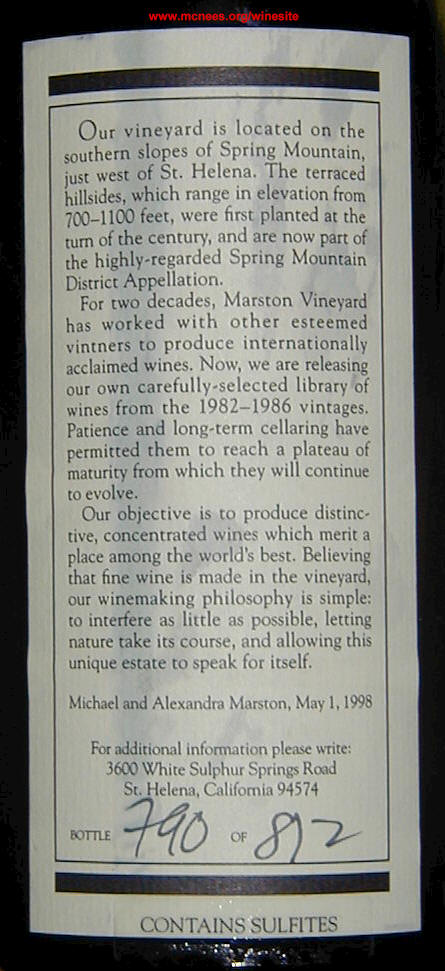
"Dec 31 - Marston (Family) Vineyard Napa Valley Petit Syrah 1984 (Bottle 790 of 812) - RM 90 - Today, 'Family' is part of the name and the winery provides cabernet fruit for Beringer Private Reserve. Not many 20 year olds down in the cellar (since the 84 Bordeaux's are long gone being a short lived vintage) but pulled this one out on the last day of 04... Surprising body, structure and backbone with inky purple colour. Intense currant, black cherry, cedar anise and plum with a firm tight long full finish. Amazing staying power and life left - thankfully I have at least one more ... 2014?

From the Marston (Family) Vineyard website - Over the last 25 years, the Marston Vineyard has produced numerous award winning wines.Andre Tchelistcheff helped craft small quantities of Cabernet Sauvignon, Petite Sirah, and Zinfandel in the early 1980’s. Sean Thackery produced legindary Petite Sirahs from the Marston Vineyard in the early 1990’s winning Best Red Wine in the world. For the last decade Beringer has been responsible for the vineyard. Cabernet Sauvignon from Marston Vineyard is in the Beringer Private reserve Cabernet. Marston Vineyard designated Cabernet is also made by Beringer. The year 1998 marked the beginning of a new era for Marston Family Vineyard. The first Marston Family Vineyard Cabernet Sauvignon was made by one of our favorite and noted winemakers, Philippe Melka."

We missed pulling this wine in its thirtieth anniversary year, 2014, but here we
are four years later. At thirty-four this is still holding its own showing surprising vibrancy and resilience and no signs of diminution from age. And my earlier notes indicating we still held a bottle missed the fact we were holding two. Hence, after drinking this one, we still hold one more. As shown on the rear label of this wine, released from library in 1998, it was built for long term cellaring. It is standing up to that objective indeed!

According to the Marston Family website today regarding their wines, each vintage will remain “forever limited” to 600 cases and is produced from selected blocks on the property. According to the handwritten serial numbers on these bottles, exactly 812 bottles were produced of this wine.

Marston Family Vineyards dates back to Michael and Alexandra Marston purchasing the property back in 1969 as part of a consortium. then acquiring the remaining ownership in 1976. Back in 1969, many of the original vineyards dating back to the turn of the century were still in production.


Over the next four decades, Marston Family Vineyardhad a line of legendary winemakers who produced numerous award winning wines. In the early 1980’s, Philip Togni and the late Andre Tchelistcheff crafted small quantities of Cabernet Sauvignon, Napa Rhone (this Petite Sirah) and Zinfandel.
This vintage was among the vintages from 1982 – 1986 that were overseen by legendary André Tchelistcheff, who was considered America’s most influential post-Prohibition winemaker, and was notable for his contributions toward defining the style of California’s best wines, especially Cabernet Sauvignon. Called the “Dean of American winemakers”, industry giants such as Robert Mondavi and Louis Martini considered him their mentor.

Noted winemaker Sean Thackery produced legendary Petite Sirahs from the Marston Vineyard under his Sirius label through the early 1990’s including winning “Best Red Wine in the World” with the 1992 (some records say 93) vintage.

Noted winemaker Philippe Melka and his team managed the property and winemaking for a dozen vintages up until 2010. During this time they began replanting certain blocks of the vineyard, and in 1998 released the first vintage under the current label. 

The release of the 2010 vintage marked the first release of current winemaker, Marbue Marke who continues to this day.


Marston Family Vineyards sit on the most southern slopes of Spring Mountain on the western slopes of Napa Valley above the town of St Helena. The original vineyards date back to the late 1800s and over the years were planted with as many as eleven different varietals, including Johannesburg Riesling, Pinot Blanc, Petite Sirah, Zinfandel, and Cabernet Sauvignon. This 1984 vintage of the Marston Petite Sirah was sourced from a small 3-acre plot on the property where some of those first plantings were done back as early as 1890.


As noted, this was our last remaining bottle.


Previous owner Al Menasco became a pioneer in developing new vineyard practices. He experimented with different types of vineyard spacing and planted a dozen varieties of grapes in different soil types and micro climates on the property. He kept meticulous records to discover the optimum growing conditions for these varietals.
Over the years, the family whittled the vineyard’s focus from eleven varietals to one, and the Pettit Sirah vines, like the others were replaced with Cabernet Sauvignon which is the sole focus of property today.Today the vineyards comprise about 10 percent of the 500 acres of heavily forested land on terraced hillsides that range in elevation from 700 to 1,100 feet just above the fogline resulting in extended hours of sunlight. The additional sunshine coupled with the lower temperatures allow the fruit to ripen more slowly and uniformly, which ultimately enhances the wine’s concentration, complexity and texture. Furthermore, the rocky, mountain soils limit the vigor of the vines contributing to their fruit's richness and concentration.
We have one remaining bottle of this 1984 vintage release. Based on its storied history and amazing stamina and longevity, we'll look forward to a suitable and appropriate occasion to open it - clearly an OTBN candidate in the next few years! 

Saturday, October 12, 2024

Diamond Mtn Napa Cab Duo for birthday celebration gathering

 Napa Cabernet Diamond Mtn Duo and aged Birthyear vintage for birthday celebration gathering

Son Sean and D-in-law Michelle hosted a gala family and friends gathering for grand-daughter Lavender’s third birthday. 

As we typically do when we get together for such occasions, Son Ryan and I coordinated our wine selections for a comparison tasting. Ryan took from his cellar a Diamond Mtn Napa Valley Cabernet, so, I took one from the same appellation for a comparison tasting. 

The kids were entertained with a bounce house, mini soccer nets and bags. 

Having just returned from DisneyLand, the young grand-daughters were enchanted by the princesses there and hence were delighted to be visited by Princess Cinderella for the occasion.   


Meanwhile, we enjoyed a comparison tasting of two wines from the Napa Valley Diamond Mountain appellation. While I can’t determine one way or the other, I am intrigued by the possibility that these two wines might be sourced from not only the same appellation, but perhaps the same vineyard, or nearby vineyards. 

Cliff Lede Diamond Mountain Napa Valley Cabernet Sauvignon 2015

This is one of Ryan’s favorite labels from the broad Cliff Lede portfolio of wines in his collection.  We have fun with this appellation since it shares the name wife/daughter-in-law Michelle, nee Diamond. 

Located at the north end of the Mayacamas Mountain range that borders the western edge forming Napa Valley, below the Napa/Sonoma border on the ridge, above the town of Calistoga, just north of St Helena, Diamond Mountain is one of the highest elevation AVAs in Napa. 

The unique terroir of the appellation is ideally suited for Bordeaux varietals such as Cabernet Sauvignon with volcanic soils, extremely high-drainage that stresses the vines, forcing them deep into the earth in search of water. The elevation makes for increased sun exposure to allow Cabernet to ripen to full maturity, yielding the kind of intensely concentrated, thick-skinned clusters that make wines with power and longevity. 

Commenting on the vineyard source for this label, Winemaker Christopher Tynan wrote: "Our Diamond Mountain Cabernet Sauvignon is from an exceptional, low-yielding vineyard with volcanic ash soils in the Diamond Mountain appellation, nestled into the Mayacamas Range on the northwest side of Napa Valley. The sun-drenched mountain vineyard has northeastern exposure and late afternoon breezes that ripen the fruit slowly and evenly. Planted and farmed by David Abreu Vineyard Management, this extraordinary site of old vines planted on a steep incline with a historic Napa field selection produces an age-worthy Cabernet Sauvignon with dark fruit, intense structure, minerality and perfume.”

“A deep garnet-black in color, this distinctly pedigreed Cabernet offers a lovely array of brooding dark fruit flavors and scents. Fresh aromas of black currant, crushed blackberries, and warm plum soar with savory layers of Chinese hoisin, black olive tapenade, and dried tobacco. The long opulent palate tastes of liquefied minerals and possesses a voluptuous raspberry liqueur-like texture. With proper time in the decanter, distinctly complex Diamond Mountain aromas of old pine forest and cedar emerge and intertwine seamlessly with the luxurious flavors."

Initially tannic and closed in youth, over a decade in bottle has allowed this single vineyard Cabernet to integrate and open up, revealing layers of dark fruits and minerality and earthy complexity. 

Knowing Ryan was bringing this single vineyard designated label, I pulled from our cellar a limited production vintage release from the same appellation. 

I am intrigued by the possibility that these wines may have sourced from the same site, or locations in close proximity. They had very similar tasting characteristics and profiles, despite the fact they were a dozen years apart. 

Marco Di Giulio "Mark K Vineyard" Diamond Mountain Cabernet Sauvignon 2002

To compare in a side by side tasting, just like an earlier tasting last year which I featured in a blogpost, excerpted here, I brought this rare limited release Diamond Mountain vineyard private label from winemaker Marco Di Giulio. We hold a half dozen different labels of Marco Di Giulio releases from legendary vineyard sources, Mt Veeder Pym Rae, Progeny and this Diamond Mountain Mark K, all between 2001 and 2004 vintages, this 2002 being the oldest of this label. 

For a period of releases, Marco Di Giulio developed unique hand-crafted wines minimalist style wines available under the winemakers' label and branding in limited quantities. They could be found in the boutique and specialist wine shops in Napa Valley or in the 'after market' via wine auctions. They were classic vineyard expressions of terrior, that unique expression of each vineyard's distinctive character, produced in very small quantities of 200 to 300 cases. His approach to winemaking was minimalist, letting the vineyard and each vintage speak for itself. As he says, he wants to “taste” each vineyard.

Marco produced his wines at Bin to Bottle, a high quality custom crush facility for a number of small Napa Vintners in South Napa where he is a partner. 

As he wrote on his Marcowines website, Marco was born and raised in San Francisco, California, shortly after his parents had emigrated from Tuscany and become successful Bay Area restaurateurs. Along with wonderful Italian meals, wine was an everyday part of their North Beach household life. As a result, Marco inherited his family's appreciation for great wine and food.

Marco developed an in-depth knowledge of winemaking and viticulture through education and experience in the industry. He graduated with a degree in Fermentation Science from the University of California at Davis in 1985.

After two years at Buena Vista Winery, Marco worked as cellar master at Pine Ridge Winery for more than four years. His next stint was as the production manager for Atlas Peak Vineyards, followed by his 1994 appointment as winemaker for Pezzi King Vineyards. Just before the 1995 harvest, he became the winemaker at Pepi Winery in Oakville. 

While making Pepi Wines, he also took charge of the Lokoya brand after the death of celebrated winemaker and mentor Greg Upton. It was at Lokoya that Marco's reputation for making world class Cabernet Sauvignon was first established.

Marco release his own label wines between 2001 and 2004. Today, Marco serves as consulting winemaker to many top labels and devotes attention to his personal projects:  Vintage Wine EstatesBin to BottleLookout Ridge and Marco DiGiulio Wines where he strives to produce wines that reflect the rugged landscapes of the vineyard sources.   

Marco Di Giulio "Mark K Vineyard" Diamond Mountain Cabernet Sauvignon 2002

Marco Di Giulio obtained the fruit for this label from Norm Kiken Cabernet Sauvignon from his
Diamond Mountain Mark K Vineyard. Marco began working with the Kiken vineyards when he was the winemaker for Lokoya. Norm Kiken became renowned for his Reverie wines and collaborated with Diguilio in sharing a few tons of Diamond Mountain Cabernet Sauvignon. 

Mr. Kiken (pronounced KICK-en) bought 40 acres on Diamond Mountain ioutside Calistoga, for $1.4 million and built himself a home and a winery, called Reverie. 

The Reverie vineyards and winery were located in a unique valley on Diamond Mountain in Napa Valley, once known as the Bonsell Property that became now divided between the iconicDiamond Creek Winery, and the former Von Strasser Winery and Reverie.

Reverie Winery specialized in producing ultra premium Bordeaux varietal blends that reflect the uniqueness of its terroir. The vineyard was principally planted in 1989 to Cabernet Sauvignon
(2 clones on 14 acres); Cabernet Franc (6 acres); Merlot (2 clones on 6 acres) and small amounts of Petit Verdot, Malbec, Barbera, Tempranillo, Grenache and Roussanne. 

For this wine, grapes were sourced from the Reverie Vineyard next to Diamond Creek and the former Von Strasser higher up on Diamond Mountain just south of Calistoga in Napa Valley. 

The 2001 vintage was a classic example of what Diamond Mountain District Cabernet Sauvignon appellation has to offer.  The aromas that jump out of the glass are pure Diamond Mountain District with loads of cherry cough drop and black cherry fruit.  The oak adds layers of spice and a warm vanilla character. 

Giulio wrote of this release, "On the palate, the wine exhibits exceptional balance and nuanced character while still being big enough to handle anything you put it up against.  As in the nose, black cherry is the predominant fruit.  The mouthfeel is silky smooth and rich and the finish seems to go on forever.  Layers of brown spices and red fruits show themselves as the wine opens up in the glass."

On release, Di Giulio wrote of this wine, my sense is that with proper cellaring, this wine could easily continue to improve for another 8 to 12 years.

It took ninety minutes to open and reveal its true character. This was similar profile to the Lede but not as dark, rich or concentrated. There was still life left in this twenty year old, showing no signs of diminution from age.

Garnet colored, medium full bodied, black berry and black raspberry fruits with notes of cassis, black tea and hints of clove spice, oak and vanilla bean with smooth polished tannins on a lingering nicely balanced acidic finish. 

RM 91 points. 

https://www.cellartracker.com/wine.asp?iWine=302285

I featured Marco Digulio wines in more detail in earlier blogposts in these pages - https://unwindwine.blogspot.com/2018/06/marco-di-guilio-pym-rae-vineyard-mt.html.

To commemorate the family occasion and gathering, I also brought from our cellar an aged Napa Cabernet from Sean’s birth year vintage. 

Spring Mountain Vineyards Spring Mountain District Napa Valley Cabernet Sauvignon 1985

Over the years I collected birth year vintage releases for each of our kids, and then most recently, for our grandkids. The kids’ birth year wines are past their prime drinking windows and need to be consumed as they’re at risk of being beyond approachable drinking. At these late stages, presenting these vintage releases and trying them is a novelty and serendipitous. We nearing the end of these vintage selections. 

My CellarTracker records indicate I acquired two bottles of this release from Auction at WineBid back in 2009. 

At nearly forty years, it’s remarkable that this wine still had any life left and was approachable for tasting. The label, foil, and most importantly and relevant, the fill level and cork were still in ideal condition, a testament to the conditions in our cellar for aging appropriate wines. 

Remarkably, the producer still shows this wine in their library collection available for purchase by wine club members. 

Their notes on this label vintage release. “This long lived Cabernet Sauvignon exudes aromas of leather, maple syrup, cherry compote, dried cranberries, smoke and forest floor. The wine presents a soft approach with a solid mouth feel. The flavors on the palate mirror its aromas of dried cranberry, cherry, plum, smoke, leather and mineral.”

This wine was 100%  Caberent Sauvignon, Estate Grown & Bottled at the property high up Spring Mountain District in Napa Valley. It was aged 22 months in new French oak.

Winemaker’s Comments - “1985 was a long, warm growing season and the wines from this vintage show ripe aromas and flavors. This wine is no exception. There are sweet ripe plum aromas with loads of spice and layers of dry flowers, caramel and cocoa. The entry is full and polished, the flavors echoing the aromatic promise of dried fruits, spices and vanilla. A bit like a rum-raisin cake in a glass. The acid keeps the wine alive, though I would recommend drinking this wine in the near future and keep in mind the possibility of bottle variation with a wine of this maturity. The cork was easily extracted and in excellent shape. This is a mature Napa Valley Cabernet and will benefit from a bit of aeration.”

Additional Notes - “The grapes for this long-lived Cabernet came primarily from the Wild Horse Estate vineyard in Oakville. A small percentage of fruit came from the young Miravalle vineyard which surrounds the Villa Miravalle that is showcased on the label. The 1985 vintage had a stellar growing season that produced ripe, rich and fleshy wines with superb balance. Bud break came early and the dry, cool weather resulted in a long harvest wth even ripening - ideal weather conditions for a great vintage.”

Dark garnet colored, medium bodied, the plum fruit flavors still holding on were giving way to notes of black tea, leather, earth and the remains of accents of spice, tobacco with moderate tannins. 


Friday, August 2, 2024

Summer dinner on the patio at Chez Joel

Summer dinner on the patio at Chez Joel Bistro, Chicago, with special vintage birth year BYOB wine

Going back more than a decade it’s been a tradition of summer to have dinner on the patio at Chez Joel Bistro in Little Italy, Chicago

We dined with Son Sean and his family, MIchelle and their two daughters, our grand-daughters for whom we babysit for several days each week, including the last couple of weeks.
 

We ordered several starters before dinner - our usual Pate’, the Escargot and tonight’s special Cerviche

Pâté de deux Sortes - Duck Liver Pâté with Traditional Garnish & Toast Points

Escargots A La Bourguignon - French Snails with Garlic Butter, Pernod & Herbed Breadcrumbs

For our dinner entrees, Linda had one of the daily specials, Pan Seared Alaskan Halibut with bok choy, corn/mango salsa and pomme puree’.

Sean and I both ordered from the menu the regular Duck entree -  

Magret et Confit de Canard, Sauce à L’orange - Seared Duck Breast & Leg Confit, Wild Mushrooms, Red Cabbage, Beets, Poached Pear, Sweet Potato Puff 


Michelle ordered the Rack of Lamb chops served with pomme’ purée. 


For a special wine with dinner, I pulled from the cellar an aged vintage wine commemorating Sean’s birth year that we took BYOB.

Cos d’Estournel St. Estephe Bordeaux 1985

For a special wine with dinner, I pulled from the cellar an aged vintage wine commemorating Sean’s birth year that we took BYOB.

Chateau Cos d'Estournel is a Grand Cru vineyard located on the road from Pauillac as you enter the St. Estephe appellation. Its oriental facade is adorned with three pagoda turrets.


The estate is situated in the very south of Saint-Estèphe, just north of Pauillac's Lafite Rothschild where the south-facing vineyard slopes gently down to the Jalle du Breuil stream which separates it from the first growth Chateau Lafite Rothschild. 

We visited the iconic Chateau Cos d'Estournel with oriental facade adorned with three pagoda turrets and the Grand Cru vineyards in St. Estephe during our visit to Bordeaux in 2019. 

Cos d’Estournel St. Estephe Bordeaux 1985

In old Gascon, "cos" means "hill of pebbles", and the vineyard does consist of deep Quaternary gravels and clay on limestone bedrock. 

The Chateau Cos d'Estournel estate covers 170 acres separated from Chateau Lafite Rothschild on the southern edge, by the stream between St. Estephe and Pauillac. The gravelly soil, over a flint, limestone and silicate subsoil low in nitrogen, has eroded over centuries to form steep ridges which perfectly drain the vineyards. 

The vineyards are planted 60 percent in Cabernet Sauvignon vines, 2 percent of Cabernet Franc, and 38 percent in Merlot. Naturally, the percentage of Cabernet or Merlot in the composition of each vintage depends on the climate which favors one grape variety or the other.

In the 1855 Classification, it was classified as a second growth and remains one of the most prominent and sought-after of all Bordeaux wines. Historically, the Cabernet Sauvignon-dominant grand vin has had a high percentage of Merlot compared with other Médoc growths, although this has lessened in recent years. 

Cos d'Estournel is known to be dark, brooding and tannic when young, developing complexity and intensity with time.

1985 Cos d'Estournel, St-Estèphe

This release was awarded a concensus 93 points by Wine Advocate, Vinous and Wine Spectator. 

Still holding its own at forty years shows the age worthiness of this wine in top vintages and the 1985 from cask could have been a lighter version of the 1982 and 1953 vintages. We’ve held this since acquiring it on release back in the eighties. The foil, label and importantly the cork and fill level were all acceptable for their age. The cork was partly saturated and a bit soft but was able to be extracted by the waiter with his traditional cork screw. 

Showing its age, the color was garnet colored and a bit opaque with moderate bricking, medium bodied, ever so slight subdued nose on the concentrated red and black berry and black cherry fruits accented by leather, tobacco and spice with a hints of cedar and pain grille on a moderate finish of fine grained tannins. 

Vinous said “This bottle constitutes the best example of the 1985 that I have encountered.”

RM 89 points. 

https://www.cellartracker.com/w?13153

https://www.chezjoelbistro.com/

https://www.estournel.com/en/


Saturday, October 15, 2022

Gala Family Celebration calls for for birthyear wine

Gala Family Celebration get-together opportunity for a birth-year wine

The family gathered at son Sean's and Michelle's to celebrate granddaughter Lavender's first birthday and got a surprise announcement. Opening her first birthday gift produced a t-shirt that read, "I'm going to be a Big Sister!

Notably, I had already pulled from the cellar and brought a bottle of wine from Sean's birth year for the occasion. 

Inglenook Napa Valley "Reunion" Estate Bottled Red Wine 1985

This label is from the storied label that was one of the original pioneers producing wine in northern California and Napa Valley. 

Inglenook was founded in 1879 by Finnish sea captain Gustave Niebaum and produced perhaps the best wines in the valley until it closed in the early 1900s due to Prohibition. 

Niebaum died in 1908, but his widow re-opened the winery in the '40s and the winery returned to its earlier eminence as a top Napa producer. 

Movie producer Francis Ford Coppola enriched with cash from the legendary Godfather movies, bought 1,500 acres of vineyards from the brand in the mid-'70s. 

Under his stewardship and direction, the winery kept producing high quality wines until it was sold several times in rapid succession in the years after this vintage went into bottle. 

Several decades of producing not up-to-par quality wines ended in 2014 when Coppola purchased the name of the winery (for a ton of cash) with the hope of returning the brand to its former glory. 

The flagship Napa Cab label for the estate is Rubicon which we saw manifested on the producer's vanity plate while at lunch down the road from the estate.  

This is the Bordeaux varietal from the historic label that I acquired at auction over the years, from son Sean's birth-year vintage to hold and open for some fitting occasion such as tonight. 

This Reunion label is sourced from the three historic Inglenook estate vineyards that sit on the magnificent expansive historic property on the edge of the Napa Valley up against the Mayacamas foothills on the west side of Rutherford. 

We visited and toured the estate (right) during our Napa Valley Wine Experience in 2009. 

This was awarded 91 points by Wine Spectator back in 1989 

Our Cellartracker records indicate we acquired several bottles of this label back in 2009. A decade later this bottle showed a stained label, good filled level and a somewhat soft cork that threatened to pull apart but with care was extracted in whole using a traditional waiter's corkscrew. 

The color was dark garnet colored, medium bodied, at 37 years this was showing its age but was still consumable - the tangy dark cherry and plum flavors were overtaken by a funky barnyard earthiness and wet wood that burned off after close to an hour - but was still a bit astringent with notes of tobacco, oaky spice cedar and black tea with modest tannins on the tangy acidic finish.

RM 85 points.

https://www.cellartracker.com/wine.asp?iWine=208179

Lillian California Syrah 2016

An interesting wine I had never heard of or seen before, Ryan brought this premium artisan Syrah from his cellar. 

This is from winemaker Maggie Harrison who worked at legendary Sine Qua Non for eight years.

First released in 2004, she sources fruit for this small production artisan label from the prestigious White Hawk Vineyard in Santa Barbara County

She produces this Lillian Syrah and a some other labels from vineyards sources such as the Bien Nacido Vineyard in Santa Maria Valley, and the Stolpman Vineyard in the Santa Ynez Valley.

Lillian wines are crafted from Rhone varietals — Roussanne, Syrah and Grenache, and Cabernet Sauvignon. 

Lillian shares a winemaker, winery, and tasting room with Antica Terra, in Dundee, OR, as noted on the label, but the wine is designated California Syrah, attributing the vineyard sources of the fruit. 

Ryan opened this bottle the night before and noted the fruit was more muted than when opened. 

Dark inky purple colored, medium full bodied, tight, structured, bold, forward, concentrated black fruits with notes of cedar and hints of cassis, pepper and smoke. 

RM 91 points. 

https://www.cellartracker.com/wine.asp?iWine=3042313

https://www.lillianwinery.com/

Sunday, June 19, 2022

Dad's Day Father Son Tasting Birthyear Wines

Dad's Day Father Son Tasting Birth-year Wines 

On the eve of Father's Day, the whole family gathered for a family group photo and individual family photos so I pulled from the cellar birth-year wines for each of my three sons. 

For eldest son Ryan's 1982 birth-year, at forty years, there are very few bottles remaining as only the most ageworthy wines would last this long. The same, to a slightly less degree for son Sean's 1985 birth-year vintage wines. Youngest son Alec's 1990 birth-year vintage on the other hand was such a blockbuster, and, eight years less time elapsed, there remains numerous ageworthy selections with time left in their aging window (s). 

I talk in detail about the blockbuster 1990 vintage in this blogpost.
https://unwindwine.blogspot.com/2019/10/parents-son-dinner-features-birth-year.html

The 1982 vintage was also a highly rated vintage, considered the 'vintage of the century' for Bordeaux wines at the time, following a drought of notable vintages and a series of lackluster vintages dating back to the the 1970, sans the 1978. The best top producers' labels remain in their the safe drinking window, especially those in larger format bottles which provide for longer aging of the wines.  

I found this 1982 Bordeaux in a small bottle, hence it was time to drink, and likely past its drinking window, which it was. The 1985 Napa was surprisingly intact and still in its drinking window. We did not get to the 1990 and will save it for another day. 

Château Duhart-Milon-Rothschild Pauillac Bordeaux 1982

This is another label we collect and hold many vintages of dating back to this release. We've written often in these pages about tasting vintage releases of this label

From a half bottle that I had put into the wine cooler near the kitchen and forgotten about, otherwise we would've tried this bottle a long time ago. The fill level was high shoulder, the cork was fully saturated and soft. Ryan was able to extract the cork 80% until the final portion separated. He was able to extract that remaining portion intact with the ahso two pronged cork puller. 

Note the price tag from original purchase showing $12.95, reduced from $14.95, from back in the mid-eighties. Current sale price for this label in standard format is $219 (K&L).

The color was dark garnet colored, just beginning to take on a rust hue, medium bodied with a slight amount of the backbone structure remaining, the fruit was gone leaving only a hint of what it might have been, with damp earth, cedar, pencil shavings and a bit of funky wet wood remaining. 

This was barely, but only slightly drinkable except for the adventure of trying an aged vintage wine, take that into account for this small format bottle and its provenance, perhaps. 

A standard size bottle and a large format would still be holding on, reaching the end of the drinking window as noted by two fellow CT'ers recently wrote about this vintage release wine:

"Another very nice bottle of this wine; certainly fully mature, but holding up well. The nose offered some dried plum and blackberry, mint, bell pepper, tobacco, damp earth. The palate has resolved tannins, still a bit of acidity, good balance and is overall tasty. I don't really see any upside here, but it should hold for a while yet,' ( wrote on 5/31/2022).

"Beautiful, luxurious and mature bouquet with earth, autumn forest and mushroom impressions. On the palate earth and autumn forest as well, beautiful acidity and a great length. Complex and luxurious wine,' (o I follow), wrote on 5/8/2022).

Robert Parker's Wine Advocate gave this 94 points back in 2009 and said it was "close to full maturity at that time - a blockbuster was a sleeper of the vintage long before the Rothschilds invested so heavily in modernizing this estate as well as began making a stricter selection". Stephen Tanzer gave it 90 points, while Jancis Robinson gave it 15.5 of 20. K&L notes Neal Martin's Wine Journal gave it 91 points.

https://www.cellartracker.com/wine.asp?iWine=56560

Freemark Abbey Bosché Vineyard Napa Valley Cabernet Sauvignon 1985

For son Sean's birth-year, we pulled this 1985 Napa Cabernet. We know this label well having had more than a dozen vintages over the years. 

Ever since the principles of Freemark Abbey entered into a handshake deal with vineyard owner John Bosché, a San Francisco attorney, back in 1970, Freemark Abbey have been crafting a few hundred cases of Cabernet Sauvignon from this legendary vineyard. 

Located in the heart of the Rutherford Bench, the 21-acre vineyard Bosché Vineyard has been cited as one of the top ten vineyards in America. WineBid writes, This predominantly dry-farmed Cabernet Bosché continues year after year to produce one of the most distinctive wines in Rutherford, and remains one of our most sought-after releases. 

Freemark Abbey Bosché Vineyard Napa Valley Cabernet Sauvignon was one of Napa Valley's first vineyard-designated wines.

We've collected this bottle dating back to this release and hold nearly a dozen vintage releases up to near recent years. The current release price for this label is now $180 per bottle for the 2018 at Binny's, Chicagoland Beverage Depot superstore.   

Wine buddy, Bill and Beth, and Linda and I have visited the Freemark Abbey Napa Valley winery together on numerous visits, and acquired bottles from the library collection there for special occasions. 
 
In 2009 we toured the winery estate library and acquired 1974 and 1978 anniversary vintage labels for a special anniversary celebration dinner that night across the road at the CIA (Culinary Institute of America), Greystoke Mansion.  


We then opened a bottle of this label almost exactly a year ago on 6/14/2021. Tonight's tasting and rating of this wine was consistent with that last opening when I wrote: "While initially musty and funky, this quickly opened to reveal its true native character and tasting profile. Dark garnet colored, medium full bodied, complex but nicely integrated black berry and black cherry fruits were highlighted with notes of spicy cinnamon and clove with tones of cedar, cigar box, and dark mocha turning to long supple tannin laced tongue coating finish."

RM 90 points.

https://unwindwine.blogspot.com/2021/06/family-reveal-dinner-calls-for.html

Again as before, tonight, the label, foil and importantly, the cork and fill level were all ideal, best to be expected in a 37 year old wine, the fill level was bottom of the neck, as shown. 

Still holding on, the immediate indication of its stability and drinkability was the dark blackish garnet color, medium full bodied, firm and tight, complex, the remaining black berry fruits were accented by predominant cigar notes with some cedar, spice and earth notes on the focused finish. 

RM 90 points. 

This release was awarded 90 points by Wine Spectator who wrote a consistent review in-line with our experience tonight, "Lean, tight and concentrated with firm black cherry, plum, currant, earth and cedar flavors that are intense and lively with a narrow, focused finish. Plenty of flavor on the aftertaste." 

https://www.cellartracker.com/wine.asp?iWine=30977

Earlier, four years ago, I opened a bottle of this label, I wrote, "Incredible, amazing life left in this 33 year old, showing little sign of diminution, even at this age! Dark purplish garnet colored, medium full bodied, rich concentrated complex black berry and black cherry fruits with a subdued layer of soft cedar/camphor with cigar box and moderate acidity on the moderate tannin lingering finish."

https://www.freemarkabbey.com/wine/rutherford/cabernet-bosche

https://twitter.com/FreemarkAbbey

Showing some modicum of restraint, we did not open the LaJota 1990 Howell Mountain Napa Cabernet Sauvignon. It likely has several years of life left and we'll look forward to opening it and sharing our experience at some time in the future. 

Sunday, December 19, 2021

Christmas features birthyear and celebration wines

Christmas Family gathering features special family birthyear and celebration wines 

The entire family gathered for a festive Christmas celebration with gifts, food, holiday treats and of course, some special celebratory wines. As we've written in these pages, over the years, we've collected a horizontal selection of birthyear wines for each of our children. We served those special vintages in large format bottles at their weddings and other gala celebrations

We still hold several bottles of those wines that are getting on in years approaching or surpassing their drinking ageworthiness and drinking windows. 

Our oldest offspring, daughter Erin is in her fortieth year and her birthyear vintage, 1981 was a modest, challenging vintage for aging potential. 
 
Indeed, we served her birthyear vintage wines from large format bottles at her wedding, fifteen years ago. At that time, we wondered how well those twenty-five year old labels would show. We served premium and super premium labels that had long lives, even in the less stellar 1981 vintage. Couple that with the fact that we served large format bottles, which extend the ageworthiness of wine, and we had a great tasting experience. See Wine Bottle Sizes...Bigger is Better - Right Bottle Sizes...Bigger (or Smaller) is Better.

Tonight, at forty years, we decided its time to open these remaining vintage wines and pulled from the cellar some of the most ageworthy labels that remain. The premier bottle we opened was Château Lafite Rothschild 1981. We also opened a Château LaGrange St Julien from the same vintage. 

Château Lafite Rothschild Pauillac 1981

We visited the Château Lafite Rothschild estate during our trip to the Bordeaux region in 2018. While we focused on touring St Julien producers, we also stopped by some of the notable estates in nearby appellation of Pauillac that we own and collect. It was a delight and reverent experience to walk the grounds and adjacent vineyards of the legendary historic estates of the Pichons, Lynch Bages and Lafite Rothschild. 

Château Lafite Rothschild is one of the five First Growth Bordeaux, and one of the most famous and collected wines in the world. 

We opted to open this label from our cellar collection as well as a lesser fifth growth that will most likely be closer to the end of, or further past the end of its drinking window. To our dismay and delight, both bottles were still presentable and holding their own, albeit clearly being in their final stages of their drinkability.

Sadly, of all the estates we visited, only one, Lafite Rothschild had security personnel come out and confront us and order us off the property.  While we deeply respect their property rights and sovereignty, it made an impression of in-hospitality and un-welcomeness, such that we will avoid the label from our collecting,  buying and tasting in the future. While Lafite is legendary, there are many alternative labels available to support. 

The Lafite Rothschild estate sits outside the town of Pauillac on the border of the appellations of Pauillac and St Estephe, on the main D2 route heading north as you exit the appellation and enter the adjoining St. Estephe. 

The Chateau is surrounded by nearly 280 acres of vineyards that are well-drained and well-exposed, with soil made up of fine deep gravel, mixed with aeolian sand on a subsoil of tertiary limestone. The vineyards are divided into three sites: the hillsides around the Château, the adjacent Carruades plateau to the west, and ten+ acres to the along the highway to the north in neighbouring Saint Estèphe.

The vineyards are planted to Cabernet Sauvignon (70%), Merlot (25%), Cabernet Franc (3%) and Petit Verdot (2%). The average age of the grapevines is 39 years old but fruit from vines younger than 10 years old are not used in the Grand Vin. This means that the average age of the vines used in the Grand Vin (Château Lafite Rothschild) is closer to 45 years. The oldest plot, called “La Gravière , was planted in 1886.

We have been collecting and tasting this legendary label for significant vintages since the 1970's, our anniversary and birthyear vintages dating back to our 1974 anniversary, and this remains one of the oldest and last remaining bottles in our collection of 'collectables'. I still remember opening the 1974 vintage back upon release and then for our a couple of milestone anniversaries at 25 years and others.

At forty years, the foil, label, fill level and importantly, the cork, were all in pristine condition.  

This was awarded 91 points by Robert Parker's Wine Advocate.

Back as early as 1997, Robert Parker wrote that "This wine is close to full maturity, but it is capable of holding for another two decades."

Parker wrote: "It reveals the classic Lafite bouquet of red and black fruits, cedar, fruitcake, and tobacco-like aromas. In the mouth, this medium ruby/garnet-colored wine displays a delicacy of fruit and sweet attack, but subtle, well-defined flavors ranging from tobacco, cigar box, cedar, and fruitcake. This is a savory, soft Lafite-Rothschild that is pleasing to both the intellect and the palate. (RP)  (12/1997)"

Son Ryan took great care to extract the cork completely intact using an 'ahso' two pronged cork puller. He double decanted it with a strainer to separate the black sediment. 

The color was dark garnet color with just a slight amount of bricking on the edges. The slight funky nose burned off after a short period to reveal bright cherry aromatics. Medium bodied, smooth, polished, delicate black berry and black cherry fruits with accents of cigar box, cedar, hints of leather and graphite with a tangy acidic lingering finish. 

RM 90 points.

https://www.cellartracker.com/wine.asp?iWine=12987

www.lafite.com/en/

Château LaGrange St Julien 1981

We also pulled from the cellar another 1981 vintage Bordeaux to consume before it is too late in its drinking window.

We also visited the LaGrange estate, outside the village of St-Julien-Beychevelle during our visit to Bordeaux in 2019. It sits further 'inland' from the Gironde River estuary, not far from the adjacent estates of Château Gruaud-Larose and  Château Branaire-Ducru that we toured during our visit. 

The iconic Château that is recognized from decades of labels is more picturesque than expected or imaginable as it looks out on a small lake/pond as one approaches the estate.

The estate has turned over and undergone substantial improvements over the years and the quality of product is vastly improved today. 

Château Lagrange was founded and can be found mentioned as early as the 13th century.

The reputation of the cru was established in the 18th century by the families of Brane and Arbouet, succeeded by Jean Valère Cabarrus, who built the Tuscan Tower estate in 1820. 

In the 18th century it found favour with the American ambassador Thomas Jefferson, who placed it 3rd in his rank of personal favourites. In 1842, Château Lagrange was bought and redeveloped the property modernizing the facilities and extending the vineyard and classified third cru within the Grand Cru Saint-Julien in 1855.

After a series of crises between the 19th and 20th centuries (phylloxera, world wars), the property has risen from the ashes, notably thanks to the Suntory family who bought it in 1983 and undertook a large-scale renovation.

The property was taken over by the Japanese spirits producer Suntory in the mid 1980's. They made substantial improvements to the property and facilities through 2008 and modernized the entire winemaking facilities and cellars in 2013 which should no doubt result in increasing improvements and quality of the wines. Suntory also took over and made substantial investment in additions and improvements to nearby Château Beychevelle which we also toured while in the area.

However, the easiest way to think of Chateau Lagrange is by knowing all their vines are dispersed over 2, gently sloping, gravel hillsides, well placed in the west of the Saint Julien appellation, close to Chateau Gruaud Larose and Chateau Branaire Ducru. At the peak of their vineyards, the hillsides reach up to 24 meters, which puts their vines at the highest elevation in the Saint Julien appellation.
Read more at:https://www.thewinecellarinsider.com/bordeaux-wine-producer-profiles/bordeaux/st-julien/lagrange/
However, the easiest way to think of Chateau Lagrange is by knowing all their vines are dispersed over 2, gently sloping, gravel hillsides, well placed in the west of the Saint Julien appellation, close to Chateau Gruaud Larose and Chateau Branaire Ducru. At the peak of their vineyards, the hillsides reach up to 24 meters, which puts their vines at the highest elevation in the Saint Julien appellation.
Read more at:https://www.thewinecellarinsider.com/bordeaux-wine-producer-profiles/bordeaux/st-julien/lagrange/

Château LaGrange St Julien Bordeaux 1981

This is the oldest of several vintages of this wine dating back to this birth year vintage from Erin's vintage release in the early eighties.

Château LaGrange vineyards span nearly 300 acres and rise to an elevation of 24 meters, the highest altitude in the St Julien appellation. The vineyards are planted to 70% Cabernet Sauvignon, 25% Merlot and 5% Petit Verdot for the reds, and 80% Sauvignon Blanc, 10% Sauvignon Gris and 10% Sémillon for the whites. The vineyards have that classic St Julien pebble soil. 

This release is a blend of 65% Cabernet Sauvignon, 28% Merlot and 7% Petit Verdot. 

Earlier in its life this release was rated 92 points John Gilman, James Suckling, Wine Spectator and Wine Enthusiast, and 90 points by Wine & Spirits and Robert Parker. 

Like the Lafite above, we also obtained this upon release and have kept it in our cellar since. As such the bottle and label were in pristine condition - the bottle fill level being top of neck, the label and foil being in best expected condition for their age. Unlike the Lafite however, the cork of the LaGrange was partially saturated and crumbled upon extraction. Even with the 'ahso' two pronged cork puller, it came apart and required a combination ahso and corkscrew to remove completely. 

At forty years of age, this was amazingly holding on to its color and what remained of its structure and fruits albeit diminished to being minimal, it was still presentable and while modest, was pleasant drinking, especially considering its age. 

Like the Lafite above, Ryan double decanted this. It showed dark garnet colored, medium body with black berry and black cherry fruits turning to leather, tobacco and notes of black tea and tangy acidity on hte modest finish. 

RM 88 points. 

https://www.cellartracker.com/wine.asp?iWine=363605

https://chateau-lagrange.com/en/

https://www.ugcb.net/en/chateau-lagrange

Château Mouton Rothschild Pauillac 1985

In the spirit of opening the Château Lafite Rothschild Pauillac Bordeaux, above, we also pulled from the cellar another classic first growth Bordeaux, this Château Mouton Rothschild 1985. 

This is tribute to son Sean's birthyear, and the recent birth of his and Michelle's daughter Lavender. The classic Mouton Rothschild artist label of the 1985 vintage features an surrealist impressionist painting of demure young maidens gazing on bunches of grapes, painted by Belgium born Flemmish Expressionist Paul Delvaux. 

We only hold this vintage of this legendary first growth label in a small format half bottle so we held off opening it today, but presented it to the new parents to hold and open together on a suitable occasion of their choosing. 

I write often in these pages about bottle sizes, large and small, here is an example of a small format bottle, suitable for an intimate tasting for two! 

Like the other bottles we acquired this upon release and have been holding in our cellar ever since. The image shown is taken from a large format double magnum of this release, to better show the artist painting as rendered on the label. 

https://www.cellartracker.com/wine.asp?iWine=1582

https://www.chateau-mouton-rothschild.com/label-art/discover-the-artwork/paul-delvaux#

We also opened this hearty full throttled Aussie Shiraz Cabernet Blend for enjoyment by the group. 

Mollydooker Enchanted Path Cabernet Shiraz 2007

I write about the Mollydooker branding and history in more detail in this blogpost.  

Their portfolio of cartoonish labels are a family favorite and we open their premium labels, Enchanted Path and Carnival of Love on many family special occasions. 

Mollydooker is the handiwork of the (former) husband-and-wife winemaking team of Sarah and Sparky Marquis. Prior to starting their own label the pair produced under the Marquis Philips brand in partnership with their distributor Dan Philips. Previously, they produced award-winning wines for Australian producers including Fox Creek, Henry’s Drive, Shirvington, and others. The term Mollydooker is Australian slang for a left-handed person as both Sarah and Sparky Marquis are left-handed.

Since 2005, they focused exclusively on making their own exuberant wines which include a range of Shiraz labels and a variety of Shiraz/Cab/Merlot blends, as well as some adventuresome white wines such as The Violinist, a Verdelho varietal.

They source their fruit from 116 acres of vineyards at their winery in McLaren Vale where about 50 percent are planted in Shiraz, with the rest made up of Cabernet, Merlot, Semillon and Chardonnay. Most of their wines bear distinctive whimsical and humorous names and labels with cartoon characters. Never-the-less, many of their wines, while modestly-priced, Mollydookers are often highly rated. Their premium label, 'Velvet Glove' Shiraz retails for $175, however.  

As I wrote a while back when I blogged about this label, "This unique blend really works with the Cabernet adding breadth and depth to the big black inky purple colored full bodied Shiraz. The result is a powerful full bodied complex wine with concentrated forward chewy tongue coating black berry and black cherry fruits accented by ripe plum and spice, a layer of leather and hints of anise with fine silky tannins on the long finish".

RM 92 points.

Robert Parker's Wine Advocate gave this wine a whopping 95 points and wrote in their review: " The 2007 Enchanted Path, a blend of 67% Shiraz and 33% Cabernet Sauvignon, is aged in mostly American oak, 70% new. Purple/black colored, it has a brooding bouquet of spice box, toasty oak, mineral, espresso, black currant, and blueberry. Structured and powerful on the palate, this dense, rich effort requires 5 to 7 years of additional cellaring and will offer prime drinking from 2014 to 2028. 95+ Points (JSM) (2/2009)."

Wine Spectator gave it 91 points  and wrote: "Big, ripe and focused, offering a blast of cherry and plum, with a welcome floral note that lasts through the long, vivid finish. Has a touch of spice as the finish lingers against fine tannins. (HS) (10/2008)".

https://www.cellartracker.com/wine.asp?iWine=554810

www.mollydookerwines.com