Showing posts with label birthyear vintage. Show all posts

Sunday, May 31, 2026

Tomahawk Ribeye and Vintage Wines for Celebration dinner

Tomahawk Ribeye and Vintage wines for Celebration dinner 

We hosted son Sean and d-in-law Michelle and family for a mini-celebration dinner for a recent business and career milestone that will be announced soon. I pulled from the cellar a birthyear vintage bottle for both his and Michelle’s birthyears - two big reds to accompany the grilled tomahawk ribeye beefsteak. 

Linda also prepared sweet corn, roasted potatoes, a medley of mixed vegetables, and Sean prepared baby artichokes. 


Dunn Vineyards Napa Valley Cabernet Sauvignon 1985 

If you’re acquiring wines to commemorate a special vintage year for a future date, such as a birthyear, you select a producer with a track record for producing long lived wines, and select wine from a region that had a good harvest of quality fruit suitable for producing long-lived wines. 

Hence we hold a collection of such wines from Randy Dunn, the legendary, independent Napa Valley winemaker known for pioneering producing powerfull structured, age-worthy Cabernet Sauvignons. His 1985 Cabernet Sauvignon has shown longevity, maintaining incredible freshness and structure even four decades after harvest.

Randy Dunn helped shape the modern identity of Napa Valley. After studying enology at UC Davis, Dunn became the first head winemaker at Caymus Vineyards in 1975 where Caymus launched its legendary ultra-premium Special Selection Cabernet.

In 1978, Dunn and his wife Lori bought property atop Howell Mountain where he was instrumental in getting established the Howell Mountain AVA, which in 1983 became Napa’s first official sub-appellation.

While modern Napa moved toward micro-sorted, plush, high-alcohol wines, Dunn maintained his traditional style, crushing fruit with bits of stems intact for raw structure, and aging wines no less than thirty months in oak, crafting balanced, elegant, lower alcohol wines designed for the dinner table.

Dunn Vineyard’s Howell Mountain property is planted with 24 acres of Cabernet vines aging between 10-37 years.

We’ve written about Randy Dunn and select wines before in these blogposts -  

Dunn Vineyards and Caymus #40 Napa Valley Cabernet Sauvignons

Dunn Vineyards Napa Valley Cabernet Sauvignon 1999

We visited the Dunn Vineyards estate up at Angwin on Howell Mountain during our Napa Valley Howell Mountain Wine Experience back in 2008. We were hosted by Kristina Dunn that day but we had the privilege to meet winemaker, producer, patriarch and Napa Valley pioneer Randy Dunn. 

While not one of the larger holdings in our cellar in terms of number of bottles, it may be one of our broadest holdings in terms of number of vintages in our vertical collection of this label, and the flagship premium label Dunn Howell Mtn Cab.  We also collect Randy Dunn's "Feather" label that he produces for the Long Shadows Vintners Collection Series in Washington State

Our Cellartracker records indicate we have a vertical collection of several mixed cases of each label from almost two dozen vintages dating back to 1981. 

Selections from Vertical Collection of Dunn Napa Valley Cabernets

With Randy Dunn at Dunn estate high atop Howell Mountain.
Dunn is known for age-worthy long-lived Napa Cabernets, especially the premium Howell Mountain label.  Robert Parker tasted both Dunn labels at ten years of age in 1996 and wrote: "Two of the most impressive wines in these tastings, both of Dunn's 1986s tasted like 3-4-year old Cabernets rather than 10-year old adolescents.... Rich, pure, and youthful, this 1986 is accessible now, but will unquestionably last another 20+ years." That would bring this wine to 2016 and here we are five years later. 

Dunn Vineyards Napa Valley Cabernet Sauvignon 1985 

Back in the 1980’s this vintage release was rated 94 points and “Top 100 Wines of 1988” by Wine Spectator, and 93 points by John Gillman as late as 2021.

Amazingly, at 40 years of age this 1985 Napa Cabernet Sauvignon is still holding its own showing some but little sign of diminution from age. The fill level, foil, label and most importantly the cork, were all in good, acceptable condition. 

The bottle still has the pricetag sticker on the bottle showing $54.95, which would've been the purchase price back on release in the late 1980's. 

In his 2021 review of this label, John Gilman wrote, “I last drank the 1985 Napa cabernet from Randy Dunn back in early 2018 and felt it was starting to turn the corner. However, at one of our most recent tastings, it was back in its tannic suit and tie and demanding to be left alone in a cool corner of the cellar for another ten-plus years.’ 

“The potential here remains exceptional, but I was hoping to see even a bit more softening of the tannins, rather than a still closed and cantankerously-structured wine!” 

“The bouquet is excellent, wafting from the glass in a complex blend of cassis, sweet dark berries, stony soil tones, cigar smoke, incipient notes of petroleum jelly, pretty spice tones, a touch of road tar and cedary oak. On the palate the wine is deep, full-bodied and still pretty clenched in its tannic chassis, with a lovely core, excellent soil signature and grip, firm, chewy tannins and a long, nascently complex and still very promising finish. Was my last bottle more forward, or is this bottle from a particularly cool cellar? I am not sure, but this most recent bottle needs still more time in the cellar before it starts to drink with generosity. Someday, it should be a terrific bottle of wine! (JG) 93+” 

Wine Spectator wrote of this release - “Intense and concentrated, packed with ripe cassis, cherry and currant flavors that are rich and elegant. The acidity and tannins are crisp and juicy, offering great potential for the cellar.” 

This was dark garnet colored, medium bodied, tangy dark blackberry and black raspberry fruits holding on, accented by notes of tobacco, spice, leather, hint of graphite, espresso and cassis with nicely integrated tannins on a round lingering finish. 

RM 90 points. 

https://go.cellartracker.com/wine/18231

http://www.dunnvineyards.com/

@dunn_vineyards  


Marston Cellars Napa Valley St Helena Petit Syrah 1984 

This is the last bottle from the 1984 vintage that we hold in our cellar, since it was not a collectable year, nor a birthyear of note at that time. I wrote about this label back in 2018 in this blogpost which I repeat excerpts here. 

My notes from an earlier review of this wine back in 2004 on this label's vintage twentieth anniversary.

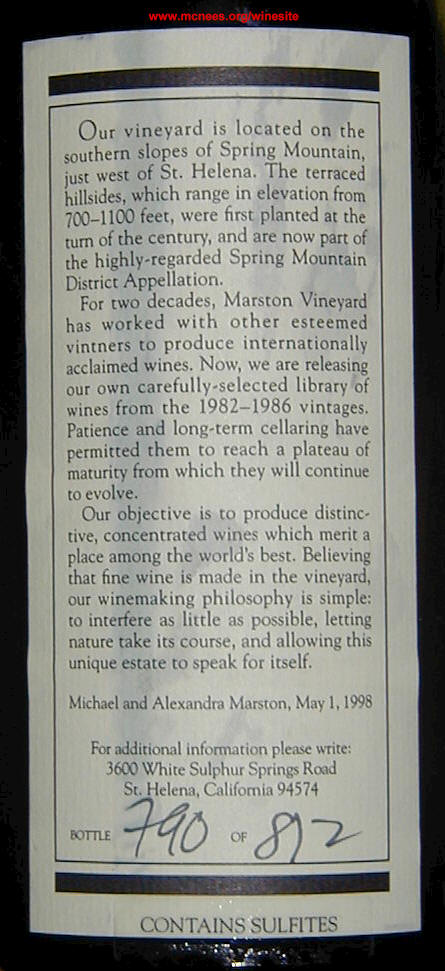
"Dec 31 - Marston (Family) Vineyard Napa Valley Petit Syrah 1984 (Bottle 790 of 812) - RM 90 - Today, 'Family' is part of the name and the winery provides cabernet fruit for Beringer Private Reserve. Not many 20 year olds down in the cellar (since the 84 Bordeaux's are long gone being a short lived vintage) but pulled this one out on the last day of 04... Surprising body, structure and backbone with inky purple colour. Intense currant, black cherry, cedar anise and plum with a firm tight long full finish. Amazing staying power and life left - thankfully I have at least one more ... 2014?

From the Marston (Family) Vineyard website - Over the last 25 years, the Marston Vineyard has produced numerous award winning wines.Andre Tchelistcheff helped craft small quantities of Cabernet Sauvignon, Petite Sirah, and Zinfandel in the early 1980’s. Sean Thackery produced legindary Petite Sirahs from the Marston Vineyard in the early 1990’s winning Best Red Wine in the world. For the last decade Beringer has been responsible for the vineyard. Cabernet Sauvignon from Marston Vineyard is in the Beringer Private reserve Cabernet. Marston Vineyard designated Cabernet is also made by Beringer. The year 1998 marked the beginning of a new era for Marston Family Vineyard. The first Marston Family Vineyard Cabernet Sauvignon was made by one of our favorite and noted winemakers, Philippe Melka."

We missed pulling this wine in its thirtieth anniversary year, 2014, but here we
are four years later. At thirty-four this is still holding its own showing surprising vibrancy and resilience and no signs of diminution from age. And my earlier notes indicating we still held a bottle missed the fact we were holding two. Hence, after drinking this one, we still hold one more. As shown on the rear label of this wine, released from library in 1998, it was built for long term cellaring. It is standing up to that objective indeed!

According to the Marston Family website today regarding their wines, each vintage will remain “forever limited” to 600 cases and is produced from selected blocks on the property. According to the handwritten serial numbers on these bottles, exactly 812 bottles were produced of this wine.

Marston Family Vineyards dates back to Michael and Alexandra Marston purchasing the property back in 1969 as part of a consortium. then acquiring the remaining ownership in 1976. Back in 1969, many of the original vineyards dating back to the turn of the century were still in production.


Over the next four decades, Marston Family Vineyardhad a line of legendary winemakers who produced numerous award winning wines. In the early 1980’s, Philip Togni and the late Andre Tchelistcheff crafted small quantities of Cabernet Sauvignon, Napa Rhone (this Petite Sirah) and Zinfandel.
This vintage was among the vintages from 1982 – 1986 that were overseen by legendary André Tchelistcheff, who was considered America’s most influential post-Prohibition winemaker, and was notable for his contributions toward defining the style of California’s best wines, especially Cabernet Sauvignon. Called the “Dean of American winemakers”, industry giants such as Robert Mondavi and Louis Martini considered him their mentor.

Noted winemaker Sean Thackery produced legendary Petite Sirahs from the Marston Vineyard under his Sirius label through the early 1990’s including winning “Best Red Wine in the World” with the 1992 (some records say 93) vintage.

Noted winemaker Philippe Melka and his team managed the property and winemaking for a dozen vintages up until 2010. During this time they began replanting certain blocks of the vineyard, and in 1998 released the first vintage under the current label. 

The release of the 2010 vintage marked the first release of current winemaker, Marbue Marke who continues to this day.


Marston Family Vineyards sit on the most southern slopes of Spring Mountain on the western slopes of Napa Valley above the town of St Helena. The original vineyards date back to the late 1800s and over the years were planted with as many as eleven different varietals, including Johannesburg Riesling, Pinot Blanc, Petite Sirah, Zinfandel, and Cabernet Sauvignon. This 1984 vintage of the Marston Petite Sirah was sourced from a small 3-acre plot on the property where some of those first plantings were done back as early as 1890.


As noted, this was our last remaining bottle.


Previous owner Al Menasco became a pioneer in developing new vineyard practices. He experimented with different types of vineyard spacing and planted a dozen varieties of grapes in different soil types and micro climates on the property. He kept meticulous records to discover the optimum growing conditions for these varietals.
Over the years, the family whittled the vineyard’s focus from eleven varietals to one, and the Pettit Sirah vines, like the others were replaced with Cabernet Sauvignon which is the sole focus of property today.Today the vineyards comprise about 10 percent of the 500 acres of heavily forested land on terraced hillsides that range in elevation from 700 to 1,100 feet just above the fogline resulting in extended hours of sunlight. The additional sunshine coupled with the lower temperatures allow the fruit to ripen more slowly and uniformly, which ultimately enhances the wine’s concentration, complexity and texture. Furthermore, the rocky, mountain soils limit the vigor of the vines contributing to their fruit's richness and concentration.
We have one remaining bottle of this 1984 vintage release. Based on its storied history and amazing stamina and longevity, we'll look forward to a suitable and appropriate occasion to open it - clearly an OTBN candidate in the next few years! 

Thursday, May 7, 2026

Old and recent reds with ribeye steaks

Old and recent Big Reds with Grilled Ribeye Beefsteaks

We hosted son Alec & daughter-in-law Vivanna and their girls for grilled rib-eye beefsteaks dinner, served with roasted potatoes, grilled mushrooms and onions, which Alec grilled while Linda prepared most of the rest of the meal, 


They came over to bring cupcakes and to have cake for/with cousin/grandaughter Lilac’s birthday for whom we were babysitting. 


I was going to pull one of the wines from the producers we visited together during our Rhône Valley Wine Experience back in 2018, but I pulled from the cellar a special, vintage aged wine from Alec’s birth year, from that southern Rhône appellation that we visited. We had just tasted this producer’s wines at the SoWal Wine Festival in (San) Destin, FL, featured in these pages in blogpost - SoWal Wine Festival Sandestin.


We also pulled a more recent vintage big red for those not so inclined to enjoy an aged vintage release, and a white to pair with the artisan cheese that Alec and Viv brought. 


On their way over, Alec & Viv picked up an artisan English Stilton Blue Cheese at Murray’s cheese-shop inside the local Mariano’s grovery. We have fun with these cheeses ever since we used to visit the original Murray’s Cheese retail shop and adjacent wine bar restaurant on Bleecker Street in Greenwich Village, Manhatten when we visited them when they were living in nearby Chelsea. 


I love this cheese selection which provided a perfect pairing with the remains of the Barsac Sauterne we had left over from our neighborhood wine tasting last week in Destin - featured in this blogpost  Neighborhood Wine Tasting and Small Bites Gathering. 

Château Cantegril Barsac Bordeaux 2019

This is a highly-regarded, unclassified sweet dessert wine produced by the Dubourdieu family, owners of the winery since 1924. The Dubourdieu family also owns Chateau Doisy Daene a producer of Classified Sauternes.

Chateau Cantegril has a 22 hectare plot on the chalky plateau of the Haut Barsac. It is located where once a fortified castle of the same name stood back in the Middle Ages.

Barsac dessert wines tend to provide high QPR - quality price ratios, as more modest variations of the neighboring Sauternes, which tend to be slightly sweeter and richer, and far more expensive, due to the very small yield of the late harvested grapes ‘Botrytisized’ grapes. 

It is a blend of primarily Sémillon, 65%, and Sauvignon Blanc, 35%, grapes grown in limestone-rich soils.

Fermentation takes place in barrels having separated each sorted pick of each individual plot. It is aged 12 months in french oak barrels.

Annual Production is 30 000 bottles

Golden colored, full bodied, thick unctuous, rich, sweet nutty caramel fruits, with notes of pear, white flowers, ginger and passionfruit, citrus, honey, and spice with balanced acidity.

RM 89 points. 


Château Boisrenard Châteauneuf-du-Pape 1990 

We opened a wine from Domaine de Beaurenard whose wine we tasted at the recent SoWal Wine Festival. It is from Chateauneuf-du-Pape, in the Rhone Valley that we visited together during our Rhone Valley Wine Experience (We visited to Château La Nerthe and Domaine du Vieux Télégraphe as the other highlight of our visit to the appellations Châteauneuf-du-Pape.)

The Domane de Beaurenard has been a family run estate for seven generations and is today run by brothers Daniel and Frederic Coulon. The estate includes 80 acres in Chateauneuf-du-Pape and 62 acres in the Cotes du Rhone Villages Rasteau appellation. Robert M. Parker Jr. calls Domaine de Beaurenard “one of the old, classic estates of Chateauneuf-du-Pape. Their two offerings include the dark-colored regular cuvee and the barrique-aged Cuvee Boisrenard…Both are top flight Chateauneuf-du-Papes…”

The winery has a tasting room located on Av. Saint-Pierre de Luxembourg, the main route as you enter the village Châteauneuf-du-Pape from the south. 

Domaine de Beaurenard is another Chateauneuf du Pape estate that can be called a true, family affair. That’s because the vineyards have been in the same family for 7 generations. Domaine de Beaurenard dates way back to 1695. At the time, it went under the name of “Bois Renard,” which as you might guess, is where the special Cuvee, used for both their red and white wines got its name.

Today, Domaine de Beaurenard is managed by Frederic Coulon and Daniel Coulon. Domaine de Beaurenard has been producing, bottling, and marketing their own wine for close to 100 years. They began making their own wine at Domaine de Beaurenard in 1929.

Domaine de Beaurenard sits in the village Chateauneuf du Pape. The estate consists of just under 80 acres of vines in the Chateauneuf du Pape appellation, 70 planted to red wine grapes and 10 are reserved for making white Chateauneuf du Pape wine. The vines are located in 25 separate parcels, with much of their Grenache planted in the Cabrieres lieu-dit east of the village.

The estate is classic, typical appellation terroir with clay, limestone, and large stones in the soil. They have old vines, with some of the Grenache dating back over 100 years. Domaine de Beaurenard also owns abiout 35 acres of vineyards in the Cotes du Rhone Villages and 150 acres of vines in the Rasteau AOC. 

While Domaine de Beaurenard grows all 13 Rhone allowed grape varieties for use in their red wine, the primary grapes used in the blend are the three required varietals; Grenache, Syrah, and Mourvèdre, plus  some Cinsault, and tiny amounts of Counoise, Muscardin, Terret and Vaccarese.

The winemaking facilities were modernized in 2004. 

This is their premiere label, sourced from the same estate vineyards and produced at the same winery as their other production labels. We’ve held this bottle in our cellar for three decades since acquiring it upon release. 

At thirty five years, the foil and label, and more importantly, the fill level and cork were still in ideal condition - evidence of the cellaring conditions for long term aging in our cellar. 

This was still in its drinking window although nearing the end as it is showing its age slightly with a slight amount of rust coloration and small bit of funkiness upon opening, which blew off for more approachability on day two. Still enjoyable drinking, it is time to drink up soon, in the next couple of years. 

This release was rated 95 points by Wine Advocate back in the summer of 2000.

The wine is aged in three different sized vats, 30 hectoliter foudres, 80 hectoliter truncated oak vats, and 228-liter oak barrels for between 9 to 18 months depending on the wine and the character of the vintage.

Winemaker Notes - “Made from parcels of old vines (60-90 years in age) planted in terroirs of great personality and complexity. Grapes picked when fully ripe and meticulously hand-sorted for extra concentration. Very low yield: 15-20 hl/hectare. These old vines were planted in a mix of varieties: the symphony of 13 varieties is thus in evidence, but with a majority of Grenache. This wine spends a long time in vats, and is matured in the most traditional ways: no filtration, 18 months' ageing in oak casks, fined with fresh egg whites, bottled and left to rest in the cellars.”

Dense ruby/purple-colored, full bodied, black fruits with hints of black tea, cassis and spice box touch of oak.

RM 90 points 

https://go.cellartracker.com/wine/30341


I also pulled a more recent Big Red Syrah for the ladies, less inclined to enjoy the mature, aged CDP. 

Lewis Cellars Ethans Syrah 2016

We love this big full throttle style of Syrah with thick, concentrated, rich round fruits. True to the wine profile, it was packaged in an extra heavy glass bottle. 

I've often written in these pages about the fun we have with this Lewis branding, with its signature 'L' on the label, ala the sit-com Laverne and Shirley, where Laverne always wore a large “L” on her sweaters,  which we also attribute to wife Linda, or her mother Lucy, or our daughter Erin Leigh, or her daughter, our first grandchild/daughter Lucy, and other grand-daughters Lavender and Lilac, when opening it for special family occasions such as tonight 

We’ve featured this producer and this label in several previous blogposts in these pages - Father's Day Special Dinner features favorite BBQ Ribs, Syrah and Zin, and Lewis Ethan's Syrah - Piazza Del Dotto Sangiovese, excerpted below.

We visited Lewis Cellars with our wine group during our Pour Boys' 2017 Napa Wine Experience, and, Alec and Viv also visited Lewis during their Napa Valley honeymoon getaway

We also have fun paying tribute to the ‘Hoosier’ heritage of proprietor Randy Lewis who was also a Indianapolis 500 race driver from our native Indiana, and, their affinity to family, naming labels after their grandkids - Alec, Ethan and Mason. We adopted Alec's Blend as a signature label for son Alec and feature it at family celebrations, we more often than not open Lewis wines for family occasions, such as tonight. 

This label, Ethan's Syrah, is made from cooler-climate vines, from mountain fruit crafted from small lots selected from Mt. Veeder and Pritchard Hill at the south end of the Vaca range on the eastern range, and Mayacamas range, respectively, on the western range forming and overlooking Napa Valley in between. 

Lewis Cellars Syrah is a nod to the great Rhône wines it's modeled after. It is aged in American oak. 

We love Lewis' style of big, spicy, concentrated wines that are balanced, yet full of black fruit and mature, mouth-coating tannins.

This was aged in American and French oak for 19 months.

This was stunningly good. Dark inky blackish purple, full bodied, concentrated, dense rich, the 100% Syrah fruit explodes in the mouth with flavors of ripe blackberries and blueberries, notes of clove spice, smoke and toast. and spice, tongue coating, chewy tannins on the long finish. Spectacular! 

RM 94 points.  

Winemaker's notes on this wine, "Savory  and  sweet  with  ripe  boysenberry  and  blue  fruit, lavender,  pancetta  and  white  truffle,  it  exudes  an  earthy,  engaging  character.  Vivid,  clean  and focused   on   the   palate,   the   wine  finishes   with  a  flourish  of  mineral   and  white  pepper."

Wine Spectator also gave this 94 points; "Plush yet well-structured, with luxurious blackberry, mocha and smoky spice flavors that build richness toward refined tannins. Drink now through 2025. — T.F."

https://www.cellartracker.com/wine.asp?iWine=3060607

https://www.lewiscellars.com/


Sunday, December 28, 2025

Christmas Celebration & Dinner

 We hosted the family for a gala Christmas celebration, exchanging of gifts, followed by dinner and an accompaniment of wine pairings. 

At grandson Jessie’s request, Linda prepared Beef Wellington, with roasted vegetables and potatoes and pasta.

Prior to dinner we served an extensive selection of artisan cheeses, charcuterie, shrimp cocktail, fresh fruits, salad and sweets with holiday punch bowl. 

We served a broad flight of wines beginning with Champagne, vintage Bordeaux and ultra-premium Napa Valley Reds. 

We started with two Brut Champagnes, both from special release festive Christmas bottles, one in large format Magnum.

G. H. Mumm Grand Cordon Brut Rose’ NV

We bought a case of this special bottling for the holidays and it has been extremely popular and well received over several dinners and holiday gatherings. I wrote about this producer and label in this blogpost about one of those events - Festive wine for Christmas Social Gathering.


Piper Heidesieck Cuvee’ Brut Champagne

There’s always room for Champagne, and always a crowd pleaser! 

I opened for the occasion this large format magnum special limited edition bottle of Piper Heidseick Brut NV Champaign.  This festive red bottle was released a couple years ago over the Christmas holidays and I bought a couple cases of the picturesque festive bottles for the holidays and for special occasions such as this. 

I also opened several of these large format bottles for son Alec and Viviana's wedding celebration dinner as featured in this blogpost at the time - Wedding Wines - Birthyear and Big Bottle Extravaganza Continues.

This is a traditional blend of primarily Pinot Noir (for structure) and Pinot Meunier (for fruit), with Chardonnay (for elegance). This is sourced from over 100 Crus (vineyard plots) throughout the Champagne region which provides consistency from vintage to vintage as well we as complexity and depth.

This perennial favorite was rated 92 points by Wine Spectator, and 90 points by Jeb Dunnuck and James Suckling.

Pale golden colored, medium bodied, creamy, fruity, fine, persistent bubbles highlight notes of fresh pear, apple, almond, hazelnut, brioche, and a touch of spice and lemon citrus with a smooth, balanced finish. 

RM 91 points. 

https://www.cellartracker.com/w?1279843


Château Figeac St Emilion Grand Cru Classe 1990

I pulled from the cellar another large format magnum of this birthyear vintage right bank Bordeaux, from one of our favorite producers. We’ve served this wine at many special occasions including birthyear vintages for the kids’ wedding and anniversary celebrations. I wrote about this producer in this blogpost following one such occasion - Birthyear vintage Silver Oak Bonny's, Figeac for father-son dinner.

Our CellarTracker records indicate we have more than a decade of vintages of this label dating back to and including our kids’ birthyear vintages, 1981, 1982, 1985 and this 1990 release, many in large format bottles. 

This right bank blend is roughly one-third each of Merlot, Cabernet Sauvignon and Cabernet Franc. It was aged in 100% new oak.

This release was rated 96 points by Decanter, 94 points by Robert Parker's Wine Advocate and 90 points by Wine Spectator and Jeb Dunnuck.

Winemaker Notes - “With its pedigree style, Château Figeac epitomises the elegance of the great wines of Bordeaux. Its unique style gradually shows through and develops over time. This great wine displays a distinctive rich nose that has wonderful aromatic complexity. On the palate, the Cabernet Sauvignon reveals lovely floral aromas in the first year then, as the wine ages, great structure on the palate. The Cabernet Franc brings lots of freshness in the tannins, and the Merlot contributes roundness and flesh. The attack on the palate is clean, the texture is silky, and the complexity elegant. The characteristic freshness of Figeac is underpinned by great length of flavor. With its long aging potential, the wine goes on in time to reveal hints of forest floor, leather, cigar-box and licorice – always with its hallmark elegance.”

Robert Parker's Wine Advocate, writing about tasting this release as part of a vertical tasting at the Château Figeac property in June 2015 said, “The 1990 Figeac was drinking gloriously and this is perhaps the best bottle that I have tasted. It is noticeably deep in color, deeper and more lucid than many vintages from the 1980s. There is something still "old school" about this Figeac, but it certainly would be my pick from this era.”

At thirty-five years, the label, foil and most importantly, the fill level were ideal for the age. The cork was partially saturated but still intact and in decent condition. 

Deep garnet colored with an ever so slight rust hue showing age, medium-bodied to full bodied, black earthy currant, berry and plum fruits with notes of black olive and black tea, tobacco leaf and hints of black truffle and smoke with with chewy tannins on a tangy lingering finish.

RM 91 points. 

https://go.cellartracker.com/wine/179893

Ryan brought from his home cellar this limited release highly allocated ultra-premium Napa Cabernet. 

Seven Apart “Shale” Napa Valley Stags Ridge Vineyard Cabernet Sauvignon 2018 

Seven Apart is from proprietor/producer Don Dady who purchased the Stags Ridge Vineyard in 2018. The property sits up on Pritchard Hill at the southern end of the Vaca Mountain range that forms the eastern wall of Napa Valley. 

At 1,400 feet, the vineyard faces the Pritchard Gap, looking to the south with a view to San Francisco Bay. At an elevation above the fog line, the site gets generous sun exposure with afternoon breezes that blow in from the San Francisco Bay to cool down the vineyard. The breeze is said to help balance the sugar levels and acidity of the grapes. 

The rocky mountain site is covered with giant rocks that winemaker Andy Erickson says “The soil is more like a cobblestone street. Scattered throughout, some of the rock are so large that we couldn’t install trellising into the ground!” According to him, the soil contributes big, round tannins and concentration to the Seven Apart Shale wine. 

The site was developed in 1999, when the volcanic rocks, some the size of small cars, were excavated, and the land was finally cleared and planted with grapevines. The resulting vineyard was named Stags Ridge.

Acclaimed winemaker Andy Erickson produces four distinct estate Seven Apart Cabernet Sauvignon wines: Seven Apart Expedition, Seven Apart Shale, Seven Apart Basalt, and Seven Apart Summit. 

“While it may seem odd to craft three Cabernet Sauvignons from the same vineyard, that’s also the challenge for me. Even within one vineyard, you might have one section that gives you one unique element and another section that gives you something completely different. I view it as my mission to create unique expressions of our dramatic vineyard site on Atlas Peak,” says Andy.

This label Seven Apart ‘Shale’ is named for the shale rock, fine-grained, laminated soil and rock in the Stags Ridge vineyard. The name refers to the ‘soft finely stratified sedimentary rock formed from consolidated mud or clay and can be split easily into fragile plates.’ As the name suggests, the “Shale” label represents the finer, more detailed side of Seven Apart winemaking. 

Winemaker notes - “Seven Apart Shale is beautifully layered,” opens Andy. “It is simultaneously hard, yet also easily pliable rock. This dichotomy of texture is really what we want the namesake wine to capture. It’s layered, but in a soft, gentle way that means you can dig into it easily.”

“While it may seem odd to craft three Cabernet Sauvignons from the same vineyard, that’s also the challenge for me. Even within one vineyard, you might have one section that gives you one unique element and another section that gives you something completely different. I view it as my mission to create unique expressions of our dramatic vineyard site on Atlas Peak,” says Andy.

Seven Apart Shale is more delicate. Andy describes the Seven Apart Shale as being crafted with softer tannins and a subtler aromatic profile.

When they harvest the grapes and collect the individual components from the different vineyard blocks,  they let them age for a year separately before they start crafting the blending. The winemaking team taste for specific components that have the elegance and finesse best suited to the Seven Apart Shale style and start forming a blend. Once the envisioned Seven Apart Shale blend is composed, the wine is aged 24 months in the finest French oak.

For the 2018 Seven Apart Shale, Andy and the Seven Apart team selected only 9 barrels to be ‘worthy of this final bottling’. Described as graceful yet powerful, the latest 2018 vintage was produced from 100% Cabernet Sauvignon from the Stags Ridge vineyard. 

Winemaker notes - “At first sight, it shows a notable black-purple hue and great density. On the nose are intense aromas of black licorice and cassis, along with savory tones of teak oil, sage, baked bread, and chaparral. The wine brims with intense berry flavors, as well as soy, thyme, and orange blossoms. Along with the voluminous palate impression, the tannins are highly polished, making for a long, velvety finish.”

This label release was rated 94 points by Vinous, 93 pints by James Suckling,

Dark purple/ruby colored, full bodied, deep rich, round, powerful, expressive concentrated but finely integrated bright vibrant ripe blackberry, black cherry and black currant fruits accent by clove spice, graphite, mint, cedar, rose petals and cassis licorice with firm but silky polished tannins on the lingering finish.  

RM 95 points. 

https://go.cellartracker.com/wine/3905517

https://sevenapart.com/behind-the-bottle-1-seven-apart-shale-cabernet-sauvignon/

https://www.cellartracker.com/w?3975575  

We dove back into our cellar to find a suitable pairing with the Seven Apart and pulled this 100 point Napa Valley Bordeaux varietal blend from the same vintage. 

Continuum Napa Valley Proprietary Red Blend 2018

Like the Seven Apart, this is 100% estate grown and made, sourced from a single vineyard, the Continuum Sage Mountain Vineyard, high up on Pritchard Hill in the Vaca Range along the eastern ridge high above the town of Oakville. 

The Continuum estate is on the backside of Pritchard Hill, over the hill opposite the David Arthur estate and vineyards that we visited during our Napa Wine Experience in 2013, as featured in this blogpost - David Arthur Napa Valley Estate Vineyards and Winery.

We also visited Pritchard Hill and the Chappellet Vineyards estate down the road back in 2009. Within sight of the Continuum estate, Pritchard hill is the home to illustrious neighbors, iconic cult wine producers including Bryant, Colgin and Dalla Valle.

Continuum is from the iconic Mondavi Family who founded this brand after selling the historic Robert Mondavi to Constellation Brands. Continuum was set up in 2005, a partnership between Tim Mondavi, his father Robert, and sister Marcia, (who lives in New York). 

Initially, they produced a Bordeaux blend with grapes sourced from the famous To Kalon vineyard. Meanwhile, after an extensive search, they found the site 70 acre vineyard on Pritchard Hill, about half, 41 acres planted to Cabernet Sauvignon, a third to Cabernet Franc, and the smaller remainder to Merlot and Petit Verdot

After years of searching hillside estates, in 2008 and 2009, the family acquired contiguous parcels on the slopes of Pritchard Hill along the eastern ridge of Napa Valley, now known as Sage Mountain Vineyard, the core of Continuum Estate. 

The Continuum estate Sage Mountain Vineyard sitting high on Pritchard Hill along the eastern ridge above Oakville, overlooks Napa Valley with views in the distance of the San Francisco Bay.

In total, the vineyard is comprised of 38 distinct vineyard blocks planted to Bordeaux varietals, Cabernet Sauvignon, Cabernet Franc, Petit Verdot, and Merlot. The vineyards sit above the fog line at an elevation of 1300 to 1600 feet facing to the western and south with some blocks with slight northern and eastern views. Continuum credits this diversity of plantings in the volcanic soils with the complexity of the estate bottled wines. The rocky, volcanic soils of the site force the vine’s energy to produce low yields that contribute to the fruit’s depth and complexity.

The first three vintages (2005–2007) of Continuum were not from today’s estate vineyard but were sourced primarily from Marjorie’s Vineyard within the historic To Kalon Vineyard in Oakville, plus some fruit from Stags Leap District.

The first three vintages of Continuum, from 2005 to 2007, were sourced primarily from Marjorie’s Vineyard within the historic To Kalon Vineyard in Oakville, located on the valley floor near the Robert Mondavi estate, representing the family’s past, plus some fruit from Stags Leap District.

Before this acquisition, the property had been a conventionally farmed, rocky 70 acre vineyard that needed extensive work; Tim brought in former Mondavi colleagues to re-graft, replant, and convert it toward organic and biodynamic practices.

Following early vintages sourcing fruit from To Kalon and Stags Leap, the 2008 vintage was the first that included some fruit from the new estate site. From the 2012 vintage onward, Continuum has been sourced exclusively from Sage Mountain Vineyard on Pritchard Hill, making it a true single-estate wine rather than a blend of purchased valley-floor fruit.

Having developed and transformed the property and vineyard, they build winery facilities, completed in 2013, establishing the ability for the first time, the family were able to grow, produce, and bottle from a single estate the product of a singular site. The year 2013 also marked Tim Mondavi’s 40th year making wine as well as the 100th anniversary of Robert’s birth.

The 2018 Continuum has an average vine age of 20 years reflecting 38 acres of mature estate vineyard, planted in 1991 and 1996, with additional plantings in 2004 and 2010. 


This 2018 release is a blend of 54% Cabernet Sauvignon, 31% Cabernet Franc, 9% Petit Verdot and 6% Merlot.

Winemakers notes - “The 2018 growing season was a winemaker’s dream given the overall cooler weather patterns paired with ample sunshine. The spring brought timely, abundant rainfall nourishing the earth and setting the stage for a healthy crop. Moderately cool temperatures post veraison allowed the fruit an extended hang time, retaining vibrancy and evolving character complexity. Berry size was smaller than average though berry count was up given the bountiful rain. Crop size was generous for the estate at 2.4 tons per acre-still quite small by any measure. Harvest began 135 days from bloom on September 27th, and continued at an unforced and purposeful pace, thanks to record cool weather in August and September. Harvest concluded on October 22nd.’

Wine Production - “Continuum is 100% estate grown, produced and bottled. All fruit is selectively hand-harvested at night. The fruit is then sorted before and after de-stemming, and gravity fed into French oak or concrete tanks. A three-day cold soak is followed by fermentation, receiving three to four pump overs daily, and délestage two to three times in total during the most active period. The wine remains on skins in tank for 20 to 40 days. All lots are then drained, basket pressed, and transferred with lees for malolactic fermentation and aging. In 2018, Continuum spent 22 months in barrel. 63 percent of French oak barrels were new and 35 percent were once used.A single concrete amphora was also used for aging.The wine clarified slowly and settled naturally in our cold barrel room, was racked sparingly and bottled without fining or filtration.Each vineyard lot was tasted and carefully considered many times to assemble the 2018 blend.”

Winemaker Notes - The 2018 Continuum shows energy and verve. The wine expresses purity and precision, with high tone aromatics of red and blue fruit, deep plum and rose oil. This vintage shows an approachable nerve of the land in the refined mineral quality on the palate. The surrounding native vegetation of bay and sage is evidenced in an earthy, savory profile. This is a shimmering, silky and harmoniously integrated wine with densely packed fine grain tannins.”

This was rated a perfect 100 points by Robert Parker's Wine Advocate, Wilfred Wong of Wine.com, and James Suckling, 99 by Wine Independent, 98 points by Vinous, 97 points by Jeb Dunnuck and Robert Parker’s Wine Advocate, and 94 points by Wine Spectator. 

Deep garnet-purple colored, full bodied, dense, concentrated, complex yet smooth, polished and elegant, integrated and balanced ripe red and black fruits, blackberry, blackcurrant and black cherry fruits with notes of mocha, cassis, graphite, black tea and dusty rose with gentle silky smooth fine grained tannins in the long finish. 

RM 96 points. 

https://go.cellartracker.com/wine/3778487

https://www.continuumestate.com/

https://www.cellartracker.com/w?3975575 

Hall Napa Valley Cabernet Sauvignon  2018

We also opened this Hall Napa Valley Cabernet from the same vintage. We’ve visited the Hall Rutherford estate vineyard and winery on numerous trips to Napa Valley, one in 2017, and previously back in 2013, and hold an extensive collection of their wines spanning more than two decades.  

Winemaker Notes - “Hall 2018 Napa Valley Cabernet is deep ruby in the glass, and displays effusive aromas of crème de cassis, dark plum, anise, and dried herbs. The palate is lush and layered with fine-grained tannins supporting flavors of dark berry, cocoa, and a hint of freshly turned earth. The long and supple finish showcases the impeccable growing season that allowed us to coax the very best from each of our unique vineyard sites.”

This was rated 93 points by Wine Spectator.

Dark garnet colored medium to full bodied, dense concentrated black berry and plum fruits with notes of cassis, dark licorice, tobacco leaf, black tea, black olive and pain grille’ with smooth polished tannins on the finish.