Showing posts with label tomahawk ribeye. Show all posts

Sunday, May 31, 2026

Tomahawk Ribeye and Vintage Wines for Celebration dinner

Tomahawk Ribeye and Vintage wines for Celebration dinner 

We hosted son Sean and d-in-law Michelle and family for a mini-celebration dinner for a recent business and career milestone that will be announced soon. I pulled from the cellar a birthyear vintage bottle for both his and Michelle’s birthyears - two big reds to accompany the grilled tomahawk ribeye beefsteak. 

Linda also prepared sweet corn, roasted potatoes, a medley of mixed vegetables, and Sean prepared baby artichokes. 


Dunn Vineyards Napa Valley Cabernet Sauvignon 1985 

If you’re acquiring wines to commemorate a special vintage year for a future date, such as a birthyear, you select a producer with a track record for producing long lived wines, and select wine from a region that had a good harvest of quality fruit suitable for producing long-lived wines. 

Hence we hold a collection of such wines from Randy Dunn, the legendary, independent Napa Valley winemaker known for pioneering producing powerfull structured, age-worthy Cabernet Sauvignons. His 1985 Cabernet Sauvignon has shown longevity, maintaining incredible freshness and structure even four decades after harvest.

Randy Dunn helped shape the modern identity of Napa Valley. After studying enology at UC Davis, Dunn became the first head winemaker at Caymus Vineyards in 1975 where Caymus launched its legendary ultra-premium Special Selection Cabernet.

In 1978, Dunn and his wife Lori bought property atop Howell Mountain where he was instrumental in getting established the Howell Mountain AVA, which in 1983 became Napa’s first official sub-appellation.

While modern Napa moved toward micro-sorted, plush, high-alcohol wines, Dunn maintained his traditional style, crushing fruit with bits of stems intact for raw structure, and aging wines no less than thirty months in oak, crafting balanced, elegant, lower alcohol wines designed for the dinner table.

Dunn Vineyard’s Howell Mountain property is planted with 24 acres of Cabernet vines aging between 10-37 years.

We’ve written about Randy Dunn and select wines before in these blogposts -  

Dunn Vineyards and Caymus #40 Napa Valley Cabernet Sauvignons

Dunn Vineyards Napa Valley Cabernet Sauvignon 1999

We visited the Dunn Vineyards estate up at Angwin on Howell Mountain during our Napa Valley Howell Mountain Wine Experience back in 2008. We were hosted by Kristina Dunn that day but we had the privilege to meet winemaker, producer, patriarch and Napa Valley pioneer Randy Dunn. 

While not one of the larger holdings in our cellar in terms of number of bottles, it may be one of our broadest holdings in terms of number of vintages in our vertical collection of this label, and the flagship premium label Dunn Howell Mtn Cab.  We also collect Randy Dunn's "Feather" label that he produces for the Long Shadows Vintners Collection Series in Washington State

Our Cellartracker records indicate we have a vertical collection of several mixed cases of each label from almost two dozen vintages dating back to 1981. 

Selections from Vertical Collection of Dunn Napa Valley Cabernets

With Randy Dunn at Dunn estate high atop Howell Mountain.
Dunn is known for age-worthy long-lived Napa Cabernets, especially the premium Howell Mountain label.  Robert Parker tasted both Dunn labels at ten years of age in 1996 and wrote: "Two of the most impressive wines in these tastings, both of Dunn's 1986s tasted like 3-4-year old Cabernets rather than 10-year old adolescents.... Rich, pure, and youthful, this 1986 is accessible now, but will unquestionably last another 20+ years." That would bring this wine to 2016 and here we are five years later. 

Dunn Vineyards Napa Valley Cabernet Sauvignon 1985 

Back in the 1980’s this vintage release was rated 94 points and “Top 100 Wines of 1988” by Wine Spectator, and 93 points by John Gillman as late as 2021.

Amazingly, at 40 years of age this 1985 Napa Cabernet Sauvignon is still holding its own showing some but little sign of diminution from age. The fill level, foil, label and most importantly the cork, were all in good, acceptable condition. 

The bottle still has the pricetag sticker on the bottle showing $54.95, which would've been the purchase price back on release in the late 1980's. 

In his 2021 review of this label, John Gilman wrote, “I last drank the 1985 Napa cabernet from Randy Dunn back in early 2018 and felt it was starting to turn the corner. However, at one of our most recent tastings, it was back in its tannic suit and tie and demanding to be left alone in a cool corner of the cellar for another ten-plus years.’ 

“The potential here remains exceptional, but I was hoping to see even a bit more softening of the tannins, rather than a still closed and cantankerously-structured wine!” 

“The bouquet is excellent, wafting from the glass in a complex blend of cassis, sweet dark berries, stony soil tones, cigar smoke, incipient notes of petroleum jelly, pretty spice tones, a touch of road tar and cedary oak. On the palate the wine is deep, full-bodied and still pretty clenched in its tannic chassis, with a lovely core, excellent soil signature and grip, firm, chewy tannins and a long, nascently complex and still very promising finish. Was my last bottle more forward, or is this bottle from a particularly cool cellar? I am not sure, but this most recent bottle needs still more time in the cellar before it starts to drink with generosity. Someday, it should be a terrific bottle of wine! (JG) 93+” 

Wine Spectator wrote of this release - “Intense and concentrated, packed with ripe cassis, cherry and currant flavors that are rich and elegant. The acidity and tannins are crisp and juicy, offering great potential for the cellar.” 

This was dark garnet colored, medium bodied, tangy dark blackberry and black raspberry fruits holding on, accented by notes of tobacco, spice, leather, hint of graphite, espresso and cassis with nicely integrated tannins on a round lingering finish. 

RM 90 points. 

https://go.cellartracker.com/wine/18231

http://www.dunnvineyards.com/

@dunn_vineyards  


Marston Cellars Napa Valley St Helena Petit Syrah 1984 

This is the last bottle from the 1984 vintage that we hold in our cellar, since it was not a collectable year, nor a birthyear of note at that time. I wrote about this label back in 2018 in this blogpost which I repeat excerpts here. 

My notes from an earlier review of this wine back in 2004 on this label's vintage twentieth anniversary.

"Dec 31 - Marston (Family) Vineyard Napa Valley Petit Syrah 1984 (Bottle 790 of 812) - RM 90 - Today, 'Family' is part of the name and the winery provides cabernet fruit for Beringer Private Reserve. Not many 20 year olds down in the cellar (since the 84 Bordeaux's are long gone being a short lived vintage) but pulled this one out on the last day of 04... Surprising body, structure and backbone with inky purple colour. Intense currant, black cherry, cedar anise and plum with a firm tight long full finish. Amazing staying power and life left - thankfully I have at least one more ... 2014?

From the Marston (Family) Vineyard website - Over the last 25 years, the Marston Vineyard has produced numerous award winning wines.Andre Tchelistcheff helped craft small quantities of Cabernet Sauvignon, Petite Sirah, and Zinfandel in the early 1980’s. Sean Thackery produced legindary Petite Sirahs from the Marston Vineyard in the early 1990’s winning Best Red Wine in the world. For the last decade Beringer has been responsible for the vineyard. Cabernet Sauvignon from Marston Vineyard is in the Beringer Private reserve Cabernet. Marston Vineyard designated Cabernet is also made by Beringer. The year 1998 marked the beginning of a new era for Marston Family Vineyard. The first Marston Family Vineyard Cabernet Sauvignon was made by one of our favorite and noted winemakers, Philippe Melka."

We missed pulling this wine in its thirtieth anniversary year, 2014, but here we
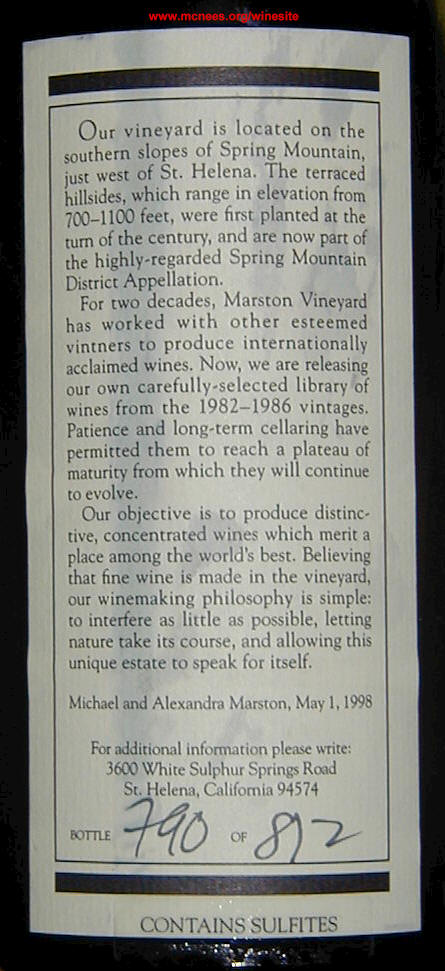
are four years later. At thirty-four this is still holding its own showing surprising vibrancy and resilience and no signs of diminution from age. And my earlier notes indicating we still held a bottle missed the fact we were holding two. Hence, after drinking this one, we still hold one more. As shown on the rear label of this wine, released from library in 1998, it was built for long term cellaring. It is standing up to that objective indeed!

According to the Marston Family website today regarding their wines, each vintage will remain “forever limited” to 600 cases and is produced from selected blocks on the property. According to the handwritten serial numbers on these bottles, exactly 812 bottles were produced of this wine.

Marston Family Vineyards dates back to Michael and Alexandra Marston purchasing the property back in 1969 as part of a consortium. then acquiring the remaining ownership in 1976. Back in 1969, many of the original vineyards dating back to the turn of the century were still in production.


Over the next four decades, Marston Family Vineyardhad a line of legendary winemakers who produced numerous award winning wines. In the early 1980’s, Philip Togni and the late Andre Tchelistcheff crafted small quantities of Cabernet Sauvignon, Napa Rhone (this Petite Sirah) and Zinfandel.
This vintage was among the vintages from 1982 – 1986 that were overseen by legendary André Tchelistcheff, who was considered America’s most influential post-Prohibition winemaker, and was notable for his contributions toward defining the style of California’s best wines, especially Cabernet Sauvignon. Called the “Dean of American winemakers”, industry giants such as Robert Mondavi and Louis Martini considered him their mentor.

Noted winemaker Sean Thackery produced legendary Petite Sirahs from the Marston Vineyard under his Sirius label through the early 1990’s including winning “Best Red Wine in the World” with the 1992 (some records say 93) vintage.

Noted winemaker Philippe Melka and his team managed the property and winemaking for a dozen vintages up until 2010. During this time they began replanting certain blocks of the vineyard, and in 1998 released the first vintage under the current label. 

The release of the 2010 vintage marked the first release of current winemaker, Marbue Marke who continues to this day.


Marston Family Vineyards sit on the most southern slopes of Spring Mountain on the western slopes of Napa Valley above the town of St Helena. The original vineyards date back to the late 1800s and over the years were planted with as many as eleven different varietals, including Johannesburg Riesling, Pinot Blanc, Petite Sirah, Zinfandel, and Cabernet Sauvignon. This 1984 vintage of the Marston Petite Sirah was sourced from a small 3-acre plot on the property where some of those first plantings were done back as early as 1890.


As noted, this was our last remaining bottle.


Previous owner Al Menasco became a pioneer in developing new vineyard practices. He experimented with different types of vineyard spacing and planted a dozen varieties of grapes in different soil types and micro climates on the property. He kept meticulous records to discover the optimum growing conditions for these varietals.
Over the years, the family whittled the vineyard’s focus from eleven varietals to one, and the Pettit Sirah vines, like the others were replaced with Cabernet Sauvignon which is the sole focus of property today.Today the vineyards comprise about 10 percent of the 500 acres of heavily forested land on terraced hillsides that range in elevation from 700 to 1,100 feet just above the fogline resulting in extended hours of sunlight. The additional sunshine coupled with the lower temperatures allow the fruit to ripen more slowly and uniformly, which ultimately enhances the wine’s concentration, complexity and texture. Furthermore, the rocky, mountain soils limit the vigor of the vines contributing to their fruit's richness and concentration.
We have one remaining bottle of this 1984 vintage release. Based on its storied history and amazing stamina and longevity, we'll look forward to a suitable and appropriate occasion to open it - clearly an OTBN candidate in the next few years! 

Sunday, May 10, 2026

Special tribute wines for Special Mom’s Mother’s Day Dinner

Special tribute wines for Special Mom’s Mother’s Day Dinner

For Mother’s Day dinner, we were joined by sons Sean and Alec, their wives, Michelle and Vivianna, and their daughters.


Linda prepared grilled Tomahawk Rib-eye beefsteaks, served with mashed potatoes, broccoli cheese casserole and grilled mushrooms, with veggie and fruit plates and ceasar salad.


For a wine accompaniment with dinner, I pulled from the cellar a wine flight that included a special label that is itself a tribute to mothers, and one that is a birthyear vintage tribute to daughter-in-law Vivianna.

With the appetizer, veggie and fruit plates and the salad course we opened this high QPR easy drinking Santa Barbara Chardonnay. 

Diatom Santa Barbara Chardonnay 2023

We featured this wine in recent blogposts - Diatom Santa Barbara County Chardonnay 2023.


Long Shadows Vintners Collection Chester Kidder Red Blend 2017

Wine legend Allen Shoup created the Long Shadows Collection of wines and named one wine in honor of his mother, Elizabeth Chester, and his grandmother, Maggie Kidder. He selected Long Shadows' Director of Winemaking and Viticulture, Gilles Nicault, to craft this New World blend of Cabernet Sauvignon, Syrah and other classic Bordeaux varieties.


The Chester-Kidder Red Blend is from Long Shadows Vintner’s Collection which I have featured often in earlier blogpost pages … Long Shadows Cellars feature a portfolio of limited release premium wines crafted by world class winemakers who specialize in particular varietal wines, all sourced from Washington State Columbia Valley fruit. 

We visited Long Shadows and featured their unique wine offerings in this earlier blogpost. 

Long Shadows was the creation of Allan Shoup, leader of Chateau St Michelle from 1983 to 2000. There he introduced Washington State grapes to winemakers from around the world in collaboration to produce quality wines. Under his leadership, Chateau St Michelle became the largest producer of Riesling varietal wines in the world. 

After retirement from Chateau St Michelle he founded Long Shadows to produce world class ultra-premium wines in Washington with fruit sourced from there. He built a state of the art winery in Walla Walla and recruited a team of legendary producers to craft signature wines from the best vineyards' fruit from the Washington Columbia Valley. Three years into the new venture Long Shadows was awarded the Winery of the Year by Food and Wine Magazine

Shoup recruited a top winemaker with expertise and a track record producing best in class wine in each category or type of wine based on a style and varietal grape. Marketed under the Vintners Collection, each of the Long Shadows labels is a testament to the legend of the winemaker for each label based on each 
varietal.

Since the beginning, Long Shadows' Director of Winemaking and Viticulture Gilles Nicault, has overseen the operations of the winery and worked closely with the vintners to bring each winemaker’s vision to completion. Internationally renowned winemakers Randy Dunn (Feather Cabernet Sauvignon); John Duval (Sequel Syrah); Philippe Melka (Pirouette Red Wine); and the late legendary Michel Rolland (Pedestal Merlot) as participating partner winemakers in their respective wines. 

Gilles also crafts Poet’s Leap Riesling and Saggi, a Sangiovese/Cabernet Sauvignon blend, in styles that remain true to their original winemakers, Armin Diel and Giovanni Folonari respectively. And finally, Gilles crafts this Chester-Kidder, a Cabernet Sauvignon/Syrah blend, independently.

Gilles Nicault has served as director of winemaking and viticulture since Long Shadows inception in 2003. As resident winemaker overseeing daily operations at Long Shadows' state-of-the-art winery in Walla Walla, Gilles works with a group of celebrated vintners from around the globe. It is his job to ensure that each winemaker's vision is realized in the vineyard and the cellar.

Gilles grew up in southern France and graduated from the University of Avignon with a four-year degree in viticulture and enology. He honed his craft in the fabled hillside wineries of Côte du Rhône, Provence and Champagne. In 1994, already a vintner of rising fame in his homeland, Gilles traveled to Washington State to expand his winemaking skills. Here he worked for several top Washington wineries, including Woodward Canyon, before joining Long Shadows. Seattle magazine named him Washington State’s Winemaker of the Year in 2016.

Gilles works closely with the state’s top growers to execute a diverse winemaking protocol at Long Shadows’ state-of-the-art facility in Walla Walla to produce wines of exceptional quality, true to the Columbia Valley’s terroir. 

We wrote about this label in several blogposts, most recently ‘Long Shadows Chester Kidder with Filet of Beef.’

It is a unique blend of Bordeaux varietals plus Shiraz/Syrah for a big bold expressive red wine, ideally suited for pairing with the grilled beefsteaks. 

We hold a half dozen vintages of this label acquired as part of our Long Shadows Vault Club allocations. For this dinner, we pulled the 2017 vintage, the same vintage and from the same appellation that we served for Linda’s birthday dinner, of another favorite Columbia Valley Red Bordeaux Blend, Force Majeure Epinette, featured in this blogpost of that special dinner - Birthday celebration dinner at Morton’s Steakhouse Naperville.

The 2017 Chester-Kidder is a blend of 68% Cabernet Sauvignon, 26% Syrah, and 6% Petit Verdot. it was aged 30 months in French oak barrels with 85% being new. 

The grapes were sourced from vineyards in Columbia Valley, Washington. The Cabernet Sauvignon was from Candy Mountain AVA and gives this wine structure and textured mouthfeel; Stone Tree Vineyard (Wahluke Slope) adds juicy, ripe cherry flavors; Dionysus Vineyard Petit Verdot, a standout site for this variety, is blended to contribute balanced acidity and dark fruit character that lifts the finished wine.

This release was rated 95 points by pundit Owen Bargreen, 94 points and Highly Recommended by International Wine Review, 93 points and Editors' Choice by Wine Enthusiast, and 93 points by Jeb Dunnuck and James Suckling, and 92 points by Stephen Tanzer.

Winemaker’s Note - Dark in color with generous aromas of wild blackberries wrapped around a pleasantly earthy core that’s accented by hints of oak spice. On the mid-palate, graphite and black licorice are complemented by a burst of vibrant fruit that lingers across a lengthy finish. A beautifully integrated wine with a broad, polished mouthfeel.

Deep dark ruby colored, full-bodied, rich, vibrant, bold concentrated savory black plum, black currant, wild blackberry and blue berry fruits accented by cassis, herbs, graphite, black tea, bacon fat, tobacco and hints of cinnamon spice and eucalyptus and oak with velvety tannins on a lengthy tongue-coating finish.

RM 93 points. 

https://www.cellartracker.com/w?3566693

https://longshadows.com/library/2017-chester-kidder/471

https://longshadows.com/


Silver Oak Napa Valley Cabernet Sauvignon 1991 

In a tribute to daughter-in-law Vivianna, the latest/newest mother in our growing family. we also opened a birth-year vintage Napa Cabernet Sauvignon we were holding in our cellar, from an iconic producer that we served at her and Alec’s wedding reception, and several other special events, as featured in these blogposts…. 

Big Bottle Birthyear wines for Wedding Celebration

Special Silver Oak Birthyear wines for Festive Holiday Open House

And, we recalled and shared our special unique visit to the Silver Oak cooperage, that is a foundation of the Silver Oak profile and brand … Silver Oak Cabernet Sauvignon is aged four years exclusively in this Missouri Oak before release … Cooper's Oak Winery and SILVER OAK Cooperage

We opened this producer’s Napa Valley label Cabernet from Viv’s birthyear vintage. We also still  hold the Alexander Valley and Bonny’s Vineyard labels of that vintage. 

At 34 years, while the label was a bit soiled, the foil, and most importantly the fill level and cork were still ideal. 

While past its prime, reaching the end of it optimal drinking window, showing a slight bit of haze or cloudiness, and taking on a bit of tartness in the aged fruit, this was still drinking nicely. 

Winemaker Notes - The 1991 Napa Valley Cabernet Sauvignon has a vibrant ruby-red color. It has a nose of bing cherry and red pepper. This wine is light to medium bodied with a medium length finish. Enjoy now. May need decanting due to light sediment.

This was rated a whopping 95 points by Robert Parker's Wine Advocate back in 1995, 93 rating from Wine Spectator, and 90 points by Wine Spectator. 

Blogger, wine writer Tom Lee publishes the Zinfandel Chronicles and featured this wine in 2018 giving it 91 points, and advising to ‘drink soon’.


Garnet colored with a slight bit of rust color and cloudiness setting in, medium bodied, dark ripe black cherry and black berry fruits starting to give way to a slight tartness, with notes of tobacco leaf, herbs, dusty rose and spice notes finishing with hints of that signature sweet oak and soft tannins and glycerin. 

RM 88 points at this stage. Time to drink up. 


Saturday, March 21, 2026

Glaetzer "Amon-Ra" Shiraz with Grilled Rib-eye Beefsteaks

Glaetzer "Amon-Ra" Shiraz Barossa Valley South Australia with Grilled Rib-eye Beefsteaks

We traveled to Dallas to visit dear friends and transplanted fellow Hoosiers Mark and Jane. Mark and I go back all the way to high school, while Linda and Jane were sorority sisters in college. 


For dinner, we picked up Tomahawk Ribeye beefsteaks to grill, and baked potatoes.


Before dinner we enjoyed an artisan Extra Aged De Graffstroot Gouda cheese with olive oil and olives, with crackers and Italian bread.
 

I picked up at their local wine shop this ultra premium label Aussie Shiraz, one of Linda's favorites, in the big bold expressive style that she loves. 


Ben Glaetzer "Amon-Ra" South Australia Barossa Valley Shiraz 2017

I told Mark to watch Linda’s response when we presented the bottle, which was immediately "Hoboken", reminiscing a memorable getaway weekend dinner when we picked up this wine and took it BYOB while visiting son Alec in NY/NJ (as featured in earlier Amon-Ra Aussie Big Shiraz for Tomahawk Dinner)
.
I wrote in my blogpost about Hoboken dinner that night, that this big powerful big red overpowered the Italian dinnerAmon-Ra Barossa Shiraz 2008 - Amon-Ra Barossa Shiraz 2008 Overpowers Italian Dinner  I chronicled this wine in that blogpost October 26, 2013:

"If you read this blog, you'll see continually that we, and especially Linda, love big bold Shiraz, so she selected this label for tonight's dinner. This was our first adventure tasting the classic AMON-Ra and this is indeed a BIG wine ... not for the feint of heart! While it overpowered our Italian fare and begs for a big steak, dark chocolate or hearty cheese,it was delicious none-the-less.'

"AMON-Ra is the flagship wine of the Glaetzer Family who have been producing Barossa Valley wines since 1888. We hold several Glaetzer wines going back a decade including one of our favorites, GoDolphin, which has since been discontinued, Wallace, Annaperenna and Bishop. The branding and labels for these wines all feature hieroglyphic symbols from ancient Egyptian mythology.' 

Note - Ben Glaetzer was named New World Winemaker of the Year in 2006.

"Since AMON-Ra was considered to be the king of all gods, winemaker Ben Glaetzer chose that symbol for his flagship, top of the line ultra-premium label. Perhaps this is fitting since the temple of AMON-Ra was believed to be the first temple to ever plant a vineyard to produce wine for the citizens of the temple.'

"The eye on front of the AMON-Ra label is the all-seeing eye of Horus or wedjat ("whole one") - a powerful Egyptian symbol of protection. It is represented as a figure with six parts, corresponding to what Egyptians regarded as the six senses; touch, taste, hearing, sight, smell and thought. Ben created AMON-Ra Shiraz to appeal to all these six senses. And it certainly does!' 

"Fruit for Glaetzer wines is sourced from the small sub-region of the northern Barossa Valley called Ebenezer. Some of the vines are as up to 80-120 years old.' 

Note, that night in Hoboken we drank the 2008 vintage release. My blogpost from then continues: "The 2008 release of AMON-Ra Shiraz is the eighth release of this label. The 2008 vintage in the Barossa was a difficult year for wine producers due to a heat spike during the vintage. As a result, Glaetzer limited the total production of AMON-Ra to maintain the quality of the wine. The strict fruit selections were rigorous and uncompromising to sacrifice quantity for quality resulting in the smallest volume released since the tiny 2003 vintage, lower than the 2007 production. This required carefully monitoring the vines and making multiple passes through the vineyards carefully selecting only grapes with the right intensity of fruit and balancing different levels of ripeness before the heat spike overstressed the fruit."

"This release was produced by winemaker Ben Glaetzer who was New World Winemaker of the Year in 2006. According to the producer, "the 2008 vintage shows great purity of fruit and firm but fine tannins, giving great structure and power to the wines."

Exceptional old vine fruit was sourced from the famed Ebenezer sub-district at the northern tip of the Barossa Valley. Vine age 50—130 years old. Yield 2 tonnes per hectare. 

In Egyptian mythology, Amon-Ra is considered to be the king of all gods. The temple of Amon-Ra was believed to be the first temple to ever plant a monoculture vineyard to produce wine for the citizens of the temple.

While Linda loves and prefers this big bold style, I tend to prefer and opt for a more balanced, elegant, complex style such as a Bordeaux varietal blend for a beefsteak or other fine dining experience. Never-the-less, this was awesome with tonight's dinner.  

This is sourced from ancient dry-grown vineyards in the renowned Ebenezer district, an important part of Australia's winemaking heritage and a living link to traditional Barossa viticulture. Select exceptional fruit from a loyal group of third and fourth generation Barossa grape growers is the backbone of Glaetzer wines. The most exceptional fruit is sourced from 80-110 year-old non-grafted bush vines which are extremely low yielding.

This wine is fermented in 1 and 2 tonne open fermenters, hand plunged 3 times daily. Bottled unfiltered to ensure minimal interventon with the wine’s natural characteristcs.

This release was matured for 16 months in 100% new oak hogshead barrels (95% French and 5% American) and matured on lees to maintain fruit profile and animation.

This release was awarded 96 points by Wine Advocate, 95 points by Vinous, 94 points by James Halliday, 92 points by James Suckling and 90 points by Wine Spectator. 

Winemaker Notes - Brooding, vibrant black with bright purple hues. Absolute purity, black fruit aromas complemented by notes of fragrant spice. Seamless, rich and full-bodied with black plum flavors intermingling with dried spice and finely balanced supple tannin. Impressive yet restrained.

The 2017 Amon Ra Shiraz is dark inky purple garnet colored, full-bodied, bold, concentrated, textured blackberry and black raspberry fruits with savory spice, notes of cassis and licorice, black tea, hints of pepper, baking spices and new oak, but it's been mostly absorbed into the wine, bit of licorice on the long finish with thick, velvety tannins. 

RM 94 points. 


http://www.glaetzer.com/

Earlier review of this wine … 
"March 27, 2007 - Ben Glaetzer Barossa Valley Amon Ra 2005 - RM 93 RP 98 - $59 - Dark berry, graphite, mineral, cassis and a hint of vanilla with long silky firm tannins on the finish. Tasted at Vino Volo at IAD." 

Sunday, June 1, 2025

Robert Craig Mt Veeder Cab with Tomahawk Ribeye

Robert Craig Mt Veeder Cab with Tomahawk Ribeye

Back home from our vacation getaway to Destin, FL, we enjoyed a grilled Tomahawk ribeye beefsteak and vintage premium Napa Cabernet for Sunday night dinner. 


This steak was one of many Linda acquired for a gala family celebration dinner recently

I pulled from the cellar this Napa Valley Cabernet Sauvignon from the Mount Veeder estate winery of the late Robin Williams, comedian and actor. I selected this label after seeing the several vintages of the ultra-premium Tesseron Pym Rae on the Premium Limited and Rare wine list at Ravello Restaurant Montgomery the other night, each listed for $750. The Tesseron global beverage empire acquired the Robin Williams estate after his passing, rebranding the wines sourced from this historic vineyard. Previously, the grapes were sold to Robert Craig winery who bottled this single appellation Mt Veeder label for more than two decades


It should be noted, the Tesseron Pym Rae release is a single vineyard designated select bottling. Notably, we also hold in our cellar two other single vineyard designated select bottling from the Pym-Rae vineyard, one released by Pilcrow, the other by Marco DiGuilio, in addition to the Tesseron label. We’ll look forward to featuring these perhaps in a comparison tasting, in a future review posting. 


We visited the Robert Craig estate winery high atop Howell Mountain on several occasions, including the Robert Craig Howell Mountain Harvest Party '09. Robert Craig Napa Valley Cabernets are instantiated in at least six different labels including this vineyard designated select Mt Veeder, and are one of the largest producer holdings in our cellar collection.

The previous time we served this wine at one of our wine dinners, it was poignant tasting and reminiscing over this wine. We recalled tasting this wine with Robert Craig on numerous occasions and he recollecting this is his favorite of the vineyard selections. 

We talked of the recent end of the supplier relationship for this fruit source as the legendary Pym Rae Vineyard, previously owned by the late Robin Williams, was sold to a major French producer who acquired the sixteen hundred acre estate and plan to enter the Napa Valley marketplace. We recall Robert's reminiscences of Robin for whom he worked and managed the vineyards back in the nineties, (telling the story how Robin William’s early winery label Toad Hollow, was named such because at an early age, he mis-pronounced his older brother Todd’s name thusly.) 

I shared these stories with Ian O’Brian, the Matre’d at Ravello, as backgrounder info on the ultra-premium wines he was featuring on their wine list. 

Robert Craig Napa Valley Mt Veeder Cabernet Sauvignon 2004

As I mentioned, Robert Craig Napa Valley Cabernets represent one of the largest holdings in our cellar. We hold variations of the portfolio dating back to the inaugural release in 1993. 

I pulled this label to commemorate the Mount Veeder estate. I selected this vintage as a ‘Goldilocks’ release, at twenty years of age, not too old, and not too young.

We still hold several bottles of this label release. I selected this particular bottle as it had the lowest fill level, however, at 21 years, it was acceptable, and the foil, label, and most importantly, the cork were still in pristine condition.

Tonight this bottle showed better than earlier tastings of this release as the fruits were more expressive and pronounced, earning an additional two points from my earlier reviews.

This release got 92 points from Connoisseur's Guide and Wine Enthusiast.

Dark garnet colored, medium full bodied, nicely integrated and well balanced, bright vibrant black cherry, black currant and black raspberry fruits accented by notes of cassis, smokey oak, dark mocha and hints of cedar with moderate dusty tannins on the lingering finish.

RM 93 points.

This is a blend of 92% Cabernet Sauvignon, 6% Merlot, & 2% Cabernet Franc.

https://www.cellartracker.com/wine.asp?iWine=347353

https://www.cellartracker.com/wine.asp?iWine=857002

https://robertcraigwine.com/

@RobertCraigWine

Sunday, May 18, 2025

Aged vintage wines for family birthday dinner

Aged vintage wines for family birthday dinner 

The family gathered at our house for a gala celebration dinner for my upcoming birthday. 

We grilled out cowboy tomahawk ribeye steaks and bbq baby back ribs, and scallops, accompanied by salad, baked beans, mashed potatoes, grilled asparagus and Mac-n-cheese (for the kids). 


The cooks, (above) Linda, master chef, and Ryan, griller and carver - naturally absent, missing from the family photo above, (as is Reid who was playing ball out in the yard with friends). 


Grilled scallops on herb buttered toast points 

For a wine accompaniment I pulled from the cellar a Sauvignon Blanc and a Chardonnay for the whites and two aged vintage big reds wines for the beef and ribs, and an aged vintage dessert wine (also a birthyear vintage). 

I also selected several younger Right Bank Bordeaux varietal wines, in the event we went through the open bottles, or needed a back-up if the first choice wines were not up to par, due to age or other conditions.  Almost regrettably, we didn’t open those wines which I was looking forward to trying, hence they’ll be available for another day. 

LaJota Napa Valley Howell Mtn Cabernet Sauvignon 1990

La Jota Vineyards in Napa Valley date back to 1888 when winemaking pioneer W.S. Keyes planted some of the first vines on Howell Mountain. Ten years later his contemporary, Fredrick Hess, built a stone winery and established La Jota Vineyard Co., named for its location on the Mexican parcel Rancho La Jota. 

Both men won medals for their Howell Mountain wines in the Paris Exposition of 1900.

La Jota Vineyard Co. continues today as a boutique producer crafting small-production mountain Cabernet Sauvignon, Merlot, Cabernet Franc, and Chardonnay, sourced from the winery’s estate and from nearby W.S. Keyes Vineyard.

Today, Howell Mountain is known for Cabernet Sauvignon in Napa’s rugged northeastern hills with its volcanic ash soils deposited millenia ago by Mount Konocti. Howell Mountain itself is a weathered volcanic "knob" with two distinct soils: crumbly white decomposed volcanic ash known as rhyolitic tuff and red, iron-laden soils of clay and volcanic rock.

La Jota estate vines develop good root systems in these well-draining, porous, nutrient-lean soils, allowing them to self-regulate the amount of water they take in. And the nutrient lean soils force the vines to struggle to survive, forcing their energy to the fruit. The result is tiny berries and clusters with very high flavor concentration.

Howell Mountain Cabernet Sauvignon was made famous by legendary wine maker Randy Dunn, who gained fame at Caymus in the 1970s and 1980s. Turning his attention to Howell Mountain, it became officially recognized as the first sub-region of Napa Valley in 1983. We visited the Dunn Vineyards estate up at Angwin on Howell Mountain during our Napa Valley Howell Mountain Wine Experience back in 2008. We were hosted by Kristina Dunn that day but we had the privilege to meet winemaker, producer, patriarch and Napa Valley pioneer Randy Dunn.

The Howell Mountain AVA includes 1,000 acres of vineyards interspersed by forestlands at the north end of the Vaca Mountain range that forms the eastern wall or Napa Valley. With vineyards at 1,400 to 2,000 feet in elevation, they sit above the fog line. The days on Howell Mountain remain cooler than those in the heart of the valley, giving the grapes a bit more time on the vine.

The soils, shallow and infertile with good drainage, are volcanic ash and red clay and produce highly concentrated berries with thick skins. The resulting wines are full of structure and potential to age.

We tasted the recent release of La Jota Howel Mtn Cabernet at the SoWal (Southwest Walton Beaches) Wine Festival in Destin, (FL) last year was one of the highlights of that event and we acquired their current release of this label at that time - Pour Boys gather for SoWal Wine Festival weekend in Destin.

Notably, LaJota was acquired by and is now part of the vast portfolio of Jackson Family Wines, who amassed a vast Billion dollar wine empire that now comprises some of the most storied labels, such as this. It was being presented by Jackson Wines at the SoWal festival. 

I wrote about Jess Jackson and the building of the family wine empire in earlier blogposts in these pages - most recently last month - La Crema Coastal Chardonnay with Homemade Chicken Piccata, and earlier, Kendall-Jackson Grand Reserve Chardonnay 2018.

And, we’ve featured other vintages of this label in other notable tastings -Boy's Night Out Cellar Tours Wine Tasting, and Dad's Day Father Son Tasting Birthyear Wines.

Today, La Jota’s winemaker is Chris Carpenter, a graduate from the University of Illinois with a BS in biology, who also earned an MBA in Chicago before working various roles in the food and beverages industry. During those years in Chicago he developed a love of food and wine, and a network of colleagues in the business.

After a visit to Napa Valley in 1993, he decided to pursue a career in wine and went on to earn a Masters in Viticulture and Enology from the University of California, Davis. 

In 1998 he found himself working as the Assistant Winemaker at Cardinale where he learned making wines from mountain terroir. In 2005 he became the Winemaker for La Jota.

Tonight we opened this vintage 1990 release,  a birthyear vintage wine of son Alec, celebrating my birthday, and he and wife Vivianna expecting (grand) baby number three. 

This release was rated 92 points by Robert Parker back in 1993, when he wrote, this wine should “reach its apogee by the turn of the century and last 20 or more years”. 

At 35 years, it has held up remarkably well, despite the tattered label, the fill level and cork were still in great condition, considering their age. 

The wine showed no signs of diminution from aging and still well within its drinking window, albeit not likely to continue aging beyond a few more years. 

Winemaker Notes - “Where rivers, creeks and property lines usually define an AVA, the Howell Mountain boundaries are defined by a 1,400 foot elevation contour line as the lowest point and the highest vineyards at 2,400 feet above sea level. The vines share the mountain with pines, oaks, madrone and the easternmost stand of the coastal redwoods.”

Opaque garnet/purple colored, medium to full bodied, rich, round concentrated black berry and black currant fruits with notes of minerals, cassis, and classic Howell Mtn spices, with firm but approachable tannins on the lingering, what Wine Spectator calls “fleshy” finish.  

RM 92 points. 

https://www.cellartracker.com/w?771991

https://www.lajotavineyardco.com/

Château du Domaine de l'Eglise Pomerol 1989

Château du Domaine de l'Eglise is a renowned producer of Right Bank Bordeaux wine, located in the commune of Pomerol, in the shadow of the church tower, and less than two kilometres, within walking distance, of notable producers Château Clinet (300m) and Château Petrus (900m). 

The Pomerol AOC (Appellation Originale Controllee) is located in the Libourne region on the Right Bank of the Dordogne River, just upstream from its confluence with the Isle. The town of Libourne, has a port that was used for exporting wines as far back as 1269. 

In the 1900s, winegrowers got together and made joint purchases. Working together, they set up a winegrowers’ and farmers’ union to improve their wine and protect the Pomerol appellation. The AOC area was defined in 1928, recognised in 1936 and revised in 2011.

Today, the Pomerol AOC is renowned for its great wines such as Pétrus, Trotanoy, Clinet, Petit Village and Gazin. The Pomerol appellation comprises around 800 hectares with 140 producers with an average of 6 hectares, producing 31,000 hectolitres of red wine a year.

The origins of the Château du Domaine de l’Église vineyard can be traced back to 1589, at the beginning of the reign of the Good King Henri (Henri IV). The estate was seized by authorities during the French Revolution and in 1793 it was sold to the Bertin family though a national property sale.

In 1893, the Bertin family produced ten barrels of wine, rising to twenty barrels by 1949. Simon Landard, Laure Bertin’s nephew, ran the estate a few years later. The estate was acquired in 1973 by Émile Castéja, 
Château du Domaine de l’Eglise was owned by Philippe Castéja and his sister, Chantal Castéja Prében-Hansen. Philippe ran the estate and improved the quality of the wine over the years. The wine from Château du Domaine de l’Eglise is considered a Grand Vin. Today the estate is run by the firm of Borie-Manoux.

The 7-hectare vineyard of Château du Domaine de l’Église is mainly planted with Merlot (95%), with a touch of Cabernet Franc (5%). The vines have an average age of 40 years.  The vineyard is situated on a plateau with classic Pomerol terroir, characterized by gravelly soil and clay subsoil, which imparts a distinct minerality to the wine. 

At thirty six years, this wine was holding up remarkably well and still very much in its drinking window, but certainly not likely to improve with any further aging, and best to be consumed in the next couple years. The label and foil and most importantly the fill level was top of neck and the cork was still intact despite being partly saturated, it was holding its integrity. It was carefully extracted using an ‘Ahso’ two pronged cork puller (shown). It likely would have collapsed in the bottle if pressed by a traditional cork screw. I always use this method, especially with older wines (except for synthetic corks).  

This release was awarded 90 points by Wine Advocate in 1993. 

This was even better the following day, being more balanced and settled, after decades of aging in the cellar.

Dark blackish garnet colored, medium to full bodied, deep rich round ripe balanced blackberry, cherry and plum fruits with herbs and vibrant spice notes with soft fine tannins on a long sensuous finish. 

RM 90 points, better, 91 points the following day. 


We also opened a birthyear vintage aged sweet dessert wine which paired perfectly with the scallops as well as the salad and later, the dessert. I wrote about this in a follow on blogpost - Clos Fontindoule Monbazillac Dessert Wine.